
Cherry Blossom Photoshoots in Japan: Timing, Locations, and What Actually Happens
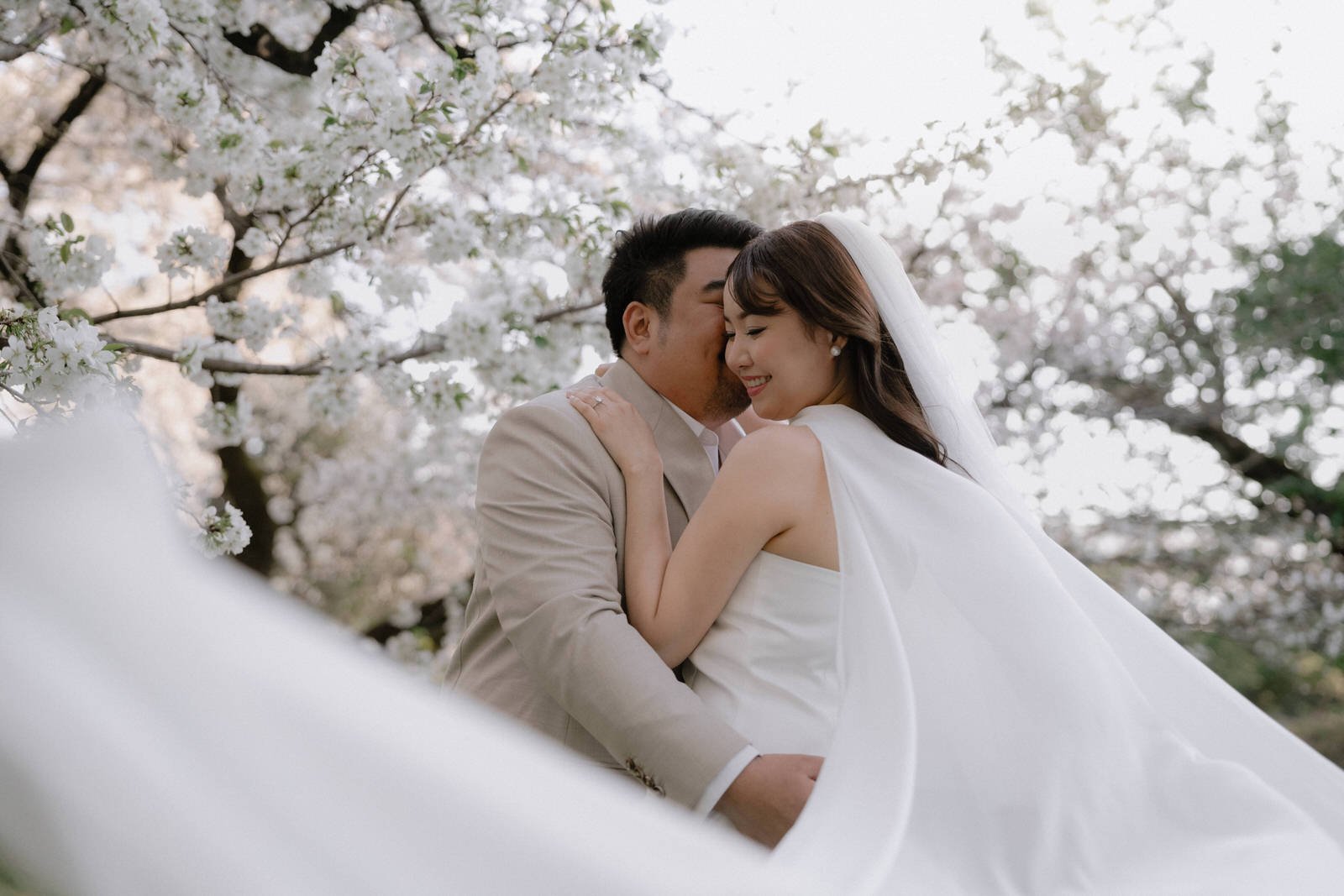
Cherry blossoms photograph well. That part isn't in question. What most planning guides don't tell you is that the version you're picturing, a wide stretch of pink blossoms with nobody else in frame, exists for about a week in any given location, and only if you're standing in the right spot at the right hour. Most published sakura guides describe the flowers. Very few describe what it's actually like to be there with a camera: which famous parks work for a shoot and which ones don't, how far the forecast can shift in the weeks before your trip, and why a spot that looks perfect on Instagram might put a picnic blanket in every frame you take. This guide is the practical version, built from photographing multiple bloom seasons across six Japanese cities.
In this guide:
How the Bloom Actually Works
Cherry blossom season lasts around two weeks in any single location, from first bloom to the last petals falling. The flowers only look their best, full bloom, for about five to seven days within that window. That's the whole season, in one sentence: two weeks of blossoms, less than a week of them at their peak.
Forecasts try to predict where that week will fall. Initial nationwide forecasts are published in January, months before anyone's actually flying out, and get revised through February and March as the season approaches. Estimated dates can move by several days, sometimes more than a week, between the first forecast and the last one. A forecast published in January is a planning tool, not a booking date.
Regional Bloom Timing
Bloom timing varies meaningfully across PMT's six destinations, and the gap between them is worth planning around rather than fighting.
| Destination | Typical Window | Notes |
|---|---|---|
| Tokyo | Late March to early April | Somei Yoshino window; Shinjuku Gyoen's mixed varieties extend the season from February into May |
| Kyoto | Late March to early April | Blooms tend to arrive together across the city rather than staggered |
| Osaka | Late March to early April | Similar timing to Kyoto |
| Nara | Late March to early April | Similar timing to Kyoto and Osaka |
| Kawaguchiko (Mount Fuji) | Mid-April | Roughly two weeks behind Tokyo and Kyoto |
| Sapporo | Late April to early May | Three to four weeks behind Tokyo and Kyoto |
Treat these as directional. Actual dates shift year to year with winter and early spring weather, which is exactly why the forecast volatility above matters more than the calendar dates themselves.
How We Actually Choose a Sakura Location
Anyone can list the ten most photographed cherry blossom parks in Japan. That list is useful for a first visit and less useful for a photoshoot. Before we recommend a spot for a session, we're weighing things a typical guide doesn't mention: how far along the bloom actually is that week, which direction the light falls through the trees, whether branches sit low enough to shoot near ground level or only work as a wide shot from a distance, how much loose background clutter a spot tends to collect, and how differently the same location behaves on a weekday morning versus a Saturday afternoon.
One more factor matters more during sakura season than almost any other time of year: how quickly a quiet spot stops being quiet once it's been published somewhere. Some of our strongest cherry blossom locations are small, local parks that most visitors never hear about, and we keep it that way on purpose. We use them for booked sessions. We don't publish their names. Across our destinations that's five such spots in Tokyo and two in Kyoto right now, chosen because they're beautiful in a way that hasn't become a destination in itself. Naming them would be the fastest way to change that.
It's the same instinct that keeps us from pulling a branch into position for a better angle anywhere we shoot cherry blossoms—petals that have already fallen are fair game for a shot, a branch bent or pulled to improve the composition isn't, even briefly. A location's ability to stay quiet, like a tree's branches, is something we're being paid to work around, not reshape. Everything below is what we can tell you honestly about the locations we do name.
Tokyo
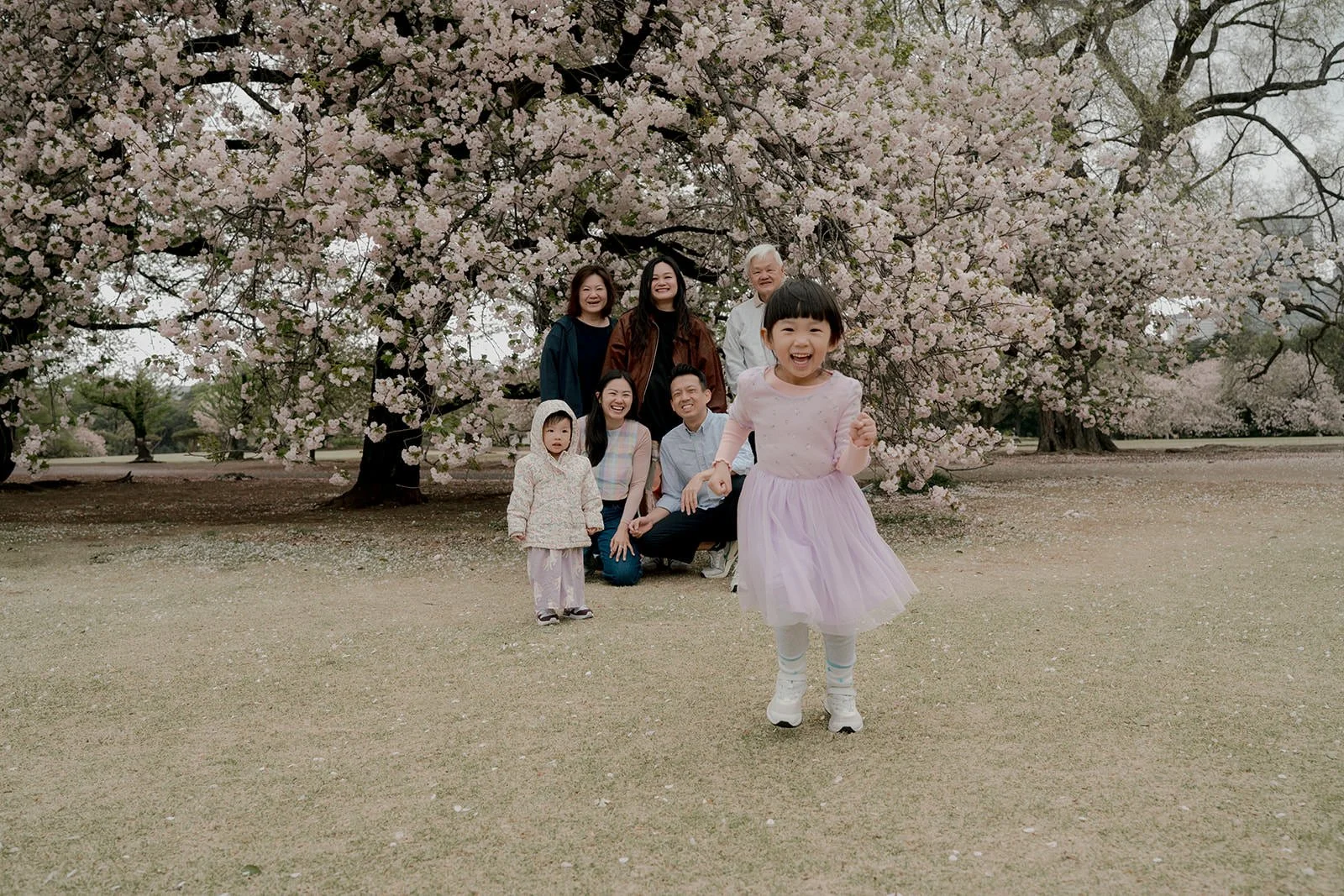
Tokyo's most famous cherry blossom photo, the one most people have already pictured, usually comes from Tokyo's Shinjuku Gyoen or the moat-side paths near Chidorigafuchi. Gyoen deserves its reputation. It holds more sakura varieties than any other park PMT works with, with something in bloom from February's earliest varieties through late bloomers into May, which gives it a longer usable window than almost anywhere else in the city. The tradeoff is that it's genuinely busy at peak. It's workable if you know which side of the park to be on and how far that is from the main gates. We arrive at 9am, right at gate opening, and that alone solves most of the crowd problem for the first hour.
Two parks work even better, and we're not going to name them. They're small, quiet, locally used, and they hold up specifically because they haven't become a destination the way Gyoen has. Weekday mornings they're close to empty. Weekends they fill up like any other park in the city. We use them for booked sessions and keep them out of published guides, for the reasons above.
Two well-known spots are worth ruling out plainly. Ueno Park is one of the most recognizable hanami locations in Tokyo, and one of the least workable for a photoshoot: the ground beneath the trees fills with picnic mats and groups from morning onward, and there's no angle that avoids them in the background. It's a fine place to bring family for the general hanami atmosphere, just not where we'd book a session. Nakameguro has the opposite problem. The canal-side walkway is narrow enough that there's little room to work around a crowd, the cherry trees along it are tall relative to the ground with few low branches to shoot from, and recent trimming has thinned the canopy further. Both are worth visiting for the experience. Neither is where we'd recommend a shoot.
The mistake we see most often with Tokyo sakura bookings has nothing to do with location. It's timing. Most people picture one specific variety, Somei Yoshino, without realizing that's what they're picturing. In Tokyo it typically blooms across a narrow window, the last week of March into the first week of April, and clients who arrive in early March or push their trip to late April, assuming they're still inside cherry blossom season in the loose sense, often find they've missed it. Gyoen's wider mix of varieties is one of the few ways to soften that risk if your dates aren't flexible.
Kyoto
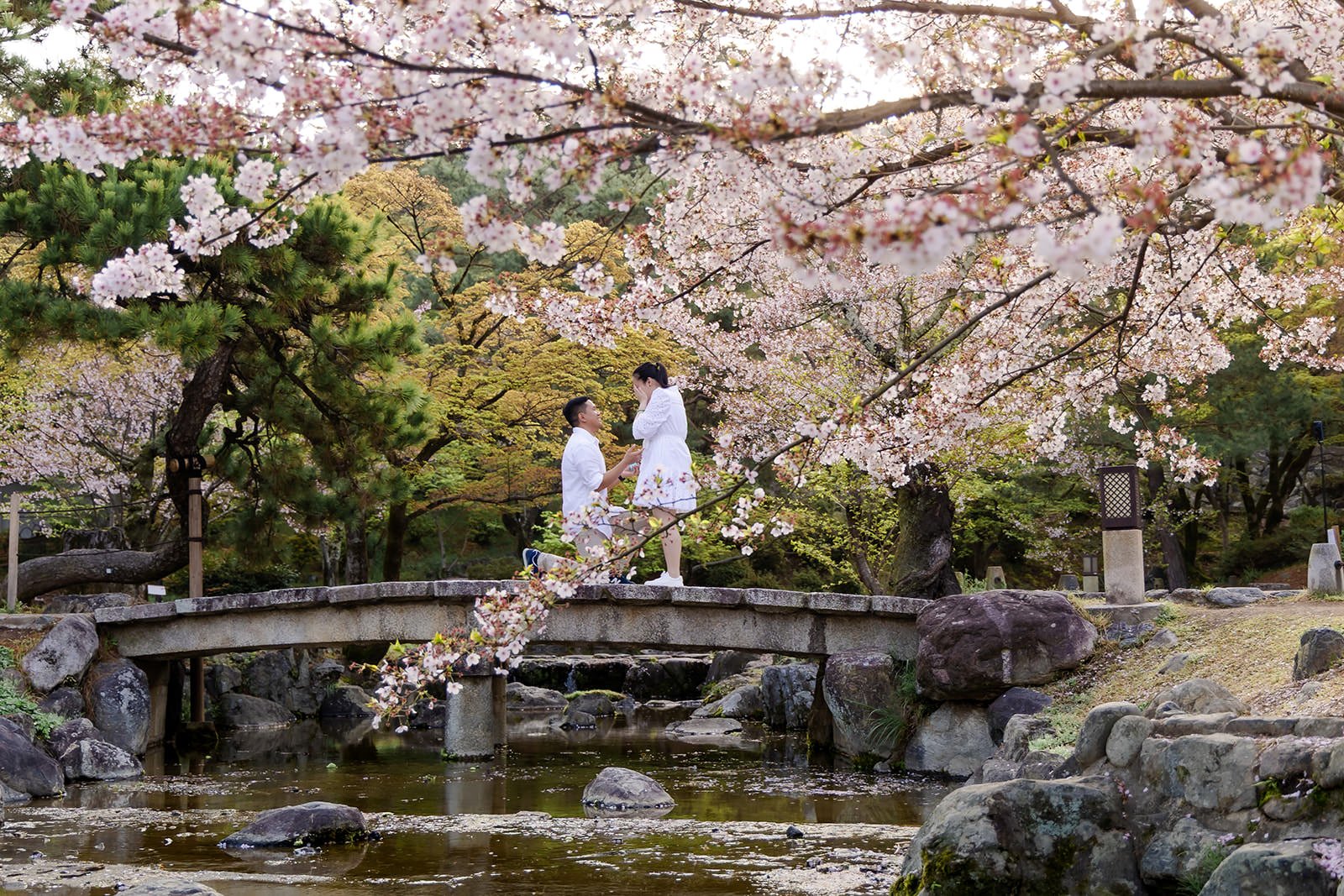
Kyoto's most photographed sakura spot, Philosopher's Path, is also one where the standard advice, arrive at dawn to beat the crowds, doesn't fully work. The path runs close to the surrounding hills with heavy tree cover on both sides, which keeps it darker than expected even at first light. It's workable. It's not our first choice. A few minutes away, Keage Incline, the disused funicular tracks near Nanzen-ji lined with cherry trees, is better lit and consistently quieter, with a rougher, less manicured feel that photographs differently than Kyoto's more formal sakura spots.
Maruyama Park has a reputation as Kyoto's busiest hanami location, and for general tourism that reputation is earned; picnic mats and food stalls surround the park's famous weeping cherry tree for most of the day. For a shoot specifically, we've found it's not as consistently crowded as that reputation suggests, in the same way Shinjuku Gyoen in Tokyo is more workable than its reputation implies once you know the timing. Mornings are the window that makes it work, and it's a solid option for couples generally.
Arashiyama's cherry blossoms behave differently than its bamboo. During sakura season most visitors stay concentrated in the bamboo grove itself, which leaves the blossom-bearing areas nearby comparatively open. Shooting early morning is still worth it here, mainly because it's the only way to combine bamboo and blossoms in the same session before either area picks up foot traffic.
Nijo Castle and the adjacent Shinsen-en garden, both strong PMT locations for Kyoto autumn foliage, don't make the cherry blossom rotation. Kyoto has two additional local spots we use for sakura and don't publish, for the same reasons covered above.
Kawaguchiko (Mount Fuji)
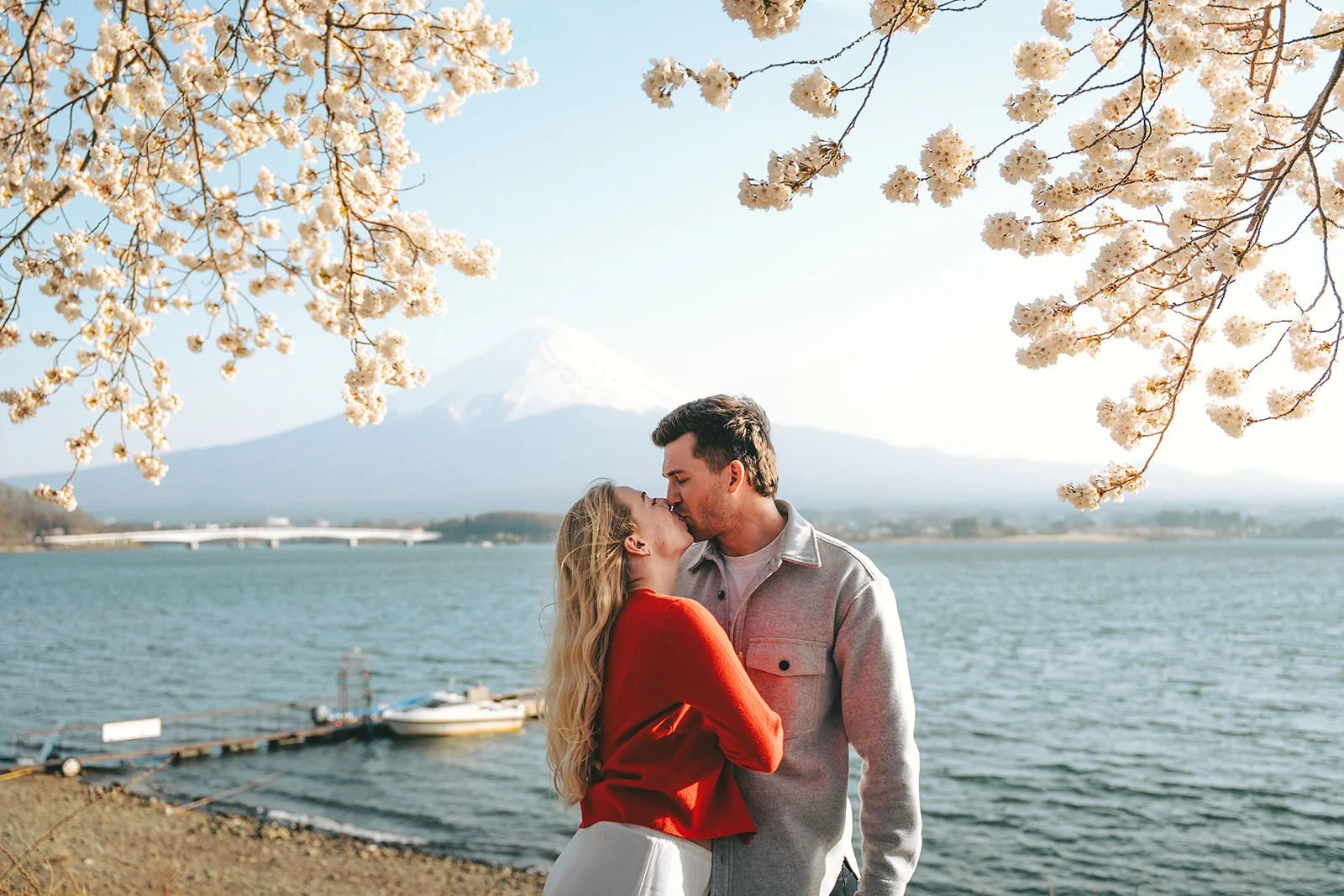
Kawaguchiko's cherry blossom season runs mid-April, roughly two weeks behind Tokyo and Kyoto's typical window. It's also, somewhat counterintuitively, a better bet for weather. The same basin geography around the lake that makes Fuji's visibility swing hour to hour doesn't translate into worse average conditions during this specific window. Kawaguchiko generally sees less rain than Tokyo or Kyoto during its own peak bloom.
The North Shore, PMT's standard Fuji-and-lake location, works the same way for sakura as it does the rest of the year: sunrise or sunset, with some flexibility on exact timing depending on conditions. We don't publish the specific spots within the North Shore that work best, for the same reason we hold back certain Tokyo and Kyoto parks. Public content points you to the North Shore in general; the exact positioning is something we work out with booked clients.
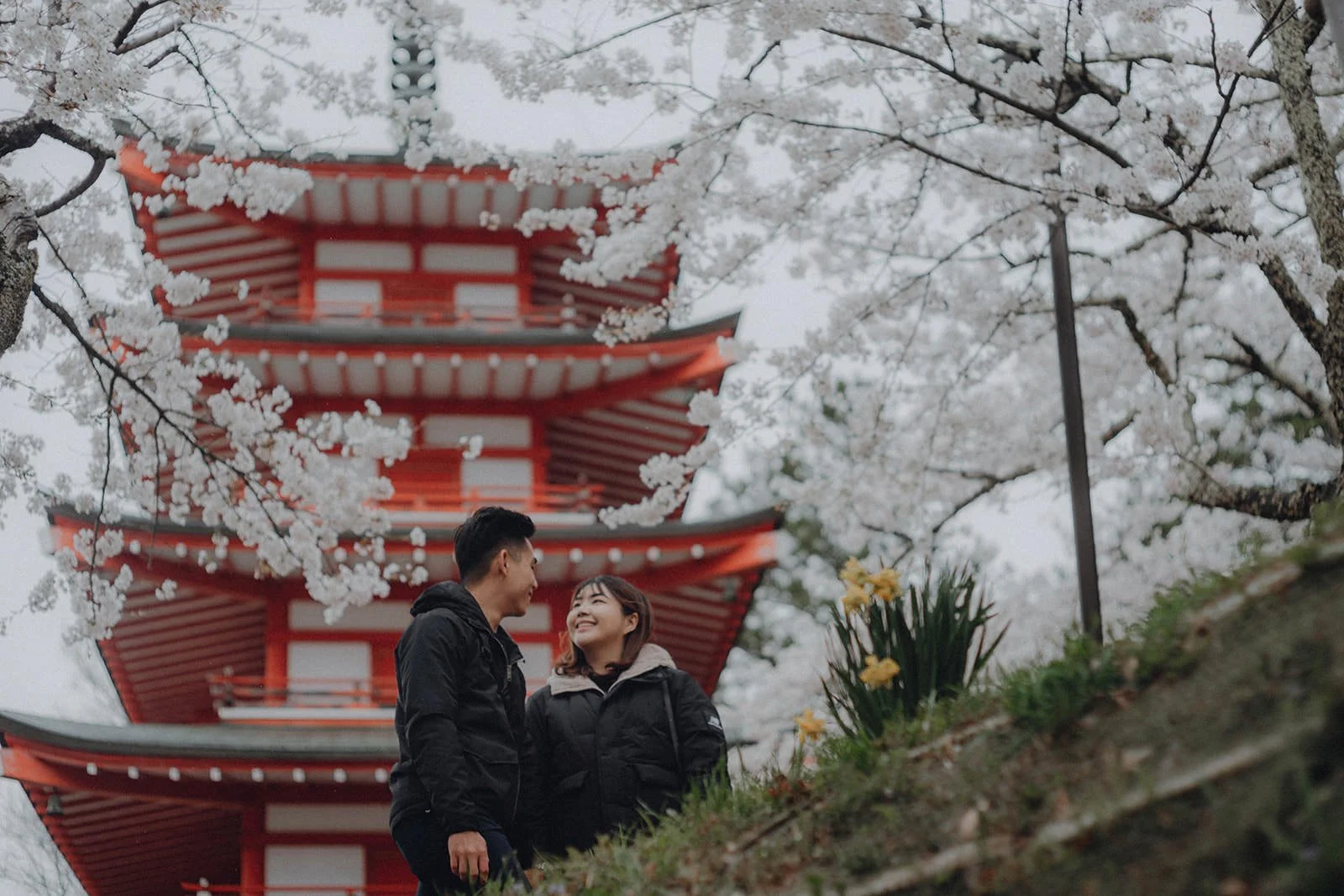
Chureito Pagoda, framed with cherry blossoms against Fuji, is one of the strongest single compositions in the Kawaguchiko area, genuinely worth the trip. It comes with a stricter rule than almost anywhere else we shoot: arrival before 7am isn't a preference here, it's a requirement. Past that point the crowds building around the pagoda's viewing platform make a clean shot very difficult.
[PHOTOGRAPHER INSIGHT: an honest, specific visibility rate for Fuji during the mid-April sakura window specifically, distinct from PMT's general Fuji-visibility notes, would strengthen this paragraph. Not yet captured.]
What we won't pretend is that Fuji is any more reliable during cherry blossom season than the rest of the year—the mountain is never guaranteed, in April or otherwise. The difference sakura season makes is what's left in the frame if Fuji doesn't cooperate: a lake shot backed by blossoms instead of bare shoreline is still a strong result, which takes some of the pressure off a proposal or pre-wedding session that can't simply wait for a clearer morning.
Osaka, Nara, and Sapporo: Shorter Windows, Fewer Crowds
These three destinations don't carry the same crowd pressure as Tokyo and Kyoto during sakura season, which changes the calculus. None of them currently need an unpublished backup spot the way Tokyo (five) and Kyoto (two) do. The public, well-known locations are enough.
Osaka
Osaka Castle Park, including the paid-admission Nishinomaru Garden closest to the keep, is PMT's confirmed sakura location here, following the same general timing patterns as our non-seasonal work at the same park. Expo '70 Commemorative Park is a newer addition to the rotation: good cherry blossom coverage, with noticeably lighter crowds than Osaka Castle Park. Dotonbori, despite being Osaka's most photographed backdrop generally, has no real sakura relevance and isn't part of this rotation.
Nara
Nara Park's defining feature, its free-roaming deer, creates a pattern that gets more pronounced during cherry blossom season. Tourists feeding the deer concentrates both animal activity and crowd density in the same spots at the same time, and a busier sakura season means more feeding, which means the effect compounds further. It's not a park-wide problem; the park is large enough that this stays localized to the feeding areas, but it's worth knowing before you plan around a specific corner of the park. The Saho River, running alongside part of Nara Park, is the general pairing most associated with Nara sakura content: deer plus a blossom-lined river walk.
Sapporo
Sapporo's cherry blossoms bloom late, generally late April into early May, three to four weeks behind Tokyo and Kyoto. That gap is the actual reason to consider it: travelers who miss the bloom further south can still catch it by heading north, provided the trip is planned around it rather than decided the week before. It's a genuine option if Hokkaido is already part of your itinerary, not a spontaneous add-on given the distance involved. Maruyama Park (a different park from Kyoto's, despite the shared name) and Moerenuma Park, an Isamu Noguchi-designed park that trades a traditional garden setting for open sky and modern geometric landscaping, are the two most commonly cited spots. PMT doesn't currently have shoot experience in Sapporo, so this section reflects general destination knowledge rather than field-tested locations. We'd rather say that plainly than imply expertise we don't have yet.
Booking a Photoshoot During Sakura Season
Sakura is PMT's tightest booking window of the year, tighter than most people expect this far out. The slots that combine the best timing with the best location, an early morning at a first-tier spot rather than a compromise, are typically gone by late January, months before the season itself. We still take last-minute requests once bloom forecasts firm up, but by then the choice is usually between the remaining availability, a mid-afternoon slot at Shinjuku Gyoen instead of a morning one, or weekend-only availability, rather than the ideal version of the same shoot.
If cherry blossom season is even a possibility for your trip, the useful move is booking around the season rather than a fixed date. Forecasts move by several days, sometimes more than a week, as the season approaches, and a Kyoto or Kawaguchiko slot slightly later than your original plan is a much better outcome than a date locked in before the blossoms cooperate. If you're still deciding between destinations for the trip overall, our comparison of Tokyo, Kyoto, and Mount Fuji covers what each is actually good for beyond sakura specifically. See our pricing page for session details, or head straight to booking if your dates are already set.
If You Miss the Bloom
A missed bloom window isn't the same as a wasted trip. The week or two after peak bloom, once most petals have fallen, still photographs well: fresh spring greenery replaces the pink, crowds thin out fast since most visitors leave once the flowers do, and the same parks that were unworkable at peak often open back up. If the timing genuinely doesn't line up anywhere on your itinerary, chasing the bloom north is a real option, not a consolation prize. Kawaguchiko runs about two weeks behind Tokyo and Kyoto, and Sapporo runs three to four weeks behind, so a trip that starts in early April still has options into May if it includes either destination. For the fuller month-by-month picture of what's in bloom or in season beyond sakura specifically, our guide to Japan's micro-seasons covers the rest of the year.
FAQ
When is the best time to photograph cherry blossoms in Japan?
It depends on the destination. Tokyo, Kyoto, Osaka, and Nara typically peak in the last week of March into the first week of April. Kawaguchiko runs about two weeks later, mid-April. Sapporo runs latest, late April into early May. See the regional timing table above for the full breakdown.
How long does cherry blossom season last?
Around two weeks in any single location, from first bloom to the last petals falling. Full bloom, when the trees look their best, lasts about five to seven days within that window.
How accurate are Japan's cherry blossom forecasts?
Directionally useful, not exact. Initial forecasts are published in January and revised through February and March as the season approaches, and estimated dates can move by several days, sometimes more than a week, between the first prediction and the last one. Treat any forecast as a planning guide rather than a fixed date.
Where can you photograph cherry blossoms in Japan without crowds?
Weekday mornings at less famous parks, arriving right at opening for gated locations, is the most reliable general approach. PMT also works a small number of quiet local spots in Tokyo and Kyoto that we don't publish, specifically to keep them that way. See How We Actually Choose a Sakura Location above.
Can you photograph Mount Fuji with cherry blossoms?
Yes. Kawaguchiko's North Shore and Chureito Pagoda both work, though Fuji's visibility is never guaranteed regardless of season, and Chureito specifically requires arrival before 7am. See the Kawaguchiko section above.
How far in advance should I book a photographer for cherry blossom season?
As early as possible once you know cherry blossom season is a realistic part of your trip. PMT's best sakura slots are typically booked by late January, well before the season itself.
What should I wear for a cherry blossom photoshoot?
The general seasonal guidance is the same as any spring shoot in Japan: light layers and colors that won't compete with the pink and white of the blossoms in frame. Our full outfit guide covers what works and what to avoid by season.