
Where to Propose in Tokyo: Real Spots, Timing, and How to Keep It a Secret
Tokyo works for a proposal because it has enough range to fit almost any version of the moment: a quiet garden bridge at sunrise, a shrine's red torii tunnel, the open deck of Shibuya Sky at sunset. PMT has planned and shot real proposals at all thirteen locations below, not researched them from a distance. That's a different kind of knowledge: knowing exactly when a spot is quiet, where a photographer can stand without being noticed, and what tends to go slightly wrong when the day doesn't run exactly to plan.
This guide covers all of that, plus how PMT keeps the whole thing a surprise until the moment itself.
In this guide:
Quick Comparison
| Location | Vibe | Crowd Level | Best Time |
|---|---|---|---|
| Hamarikyu Gardens | Waterside garden, city skyline in view | Quiet at 9am, thins out by 4pm | 4pm or 9am |
| Rikugien Gardens | Traditional garden, intimate | Quiet most of the year | 9am gate opening |
| New Otani Garden | Compact hotel garden | Quiet (avoid March grad season) | Varies |
| Shinjuku Gyoen | Botanical garden, seasonal | Quiet in right corner, busy at peak sakura | Season-dependent |
| Hibiya Park | Central garden, pond and bridge | Quiet most days | Sunset |
| Meiji Shrine | Traditional shrine, forested | Manageable even when busy | Up to 9am |
| Asakusa | Traditional streets | Quiet before 8am only | Before 8am |
| Nezu Shrine | Traditional shrine, red architecture | Quiet outside azalea season | General hours |
| Hie Shrine | Torii tunnel, shrine | Quiet, occasional queue | Mornings |
| Zojoji / Shiba Park | Temple with Tokyo Tower backdrop | Check event calendar first | Flexible |
| Marunouchi / Tokyo Station | Grand architecture | Unpredictable (tour buses) | Scout close to date |
| Shibuya Sky | Skyline, panoramic | Busy, ticketed | Sunset, book early |
| Shibuya Crossing | Urban energy, embraces the crowd | Always busy, by design | Anytime |
Every location above has real PMT proposal experience behind it. No theoretical picks, no "this looks nice in photos" guesses.
Want help figuring out which of these fits your trip and your partner? Tell us about your proposal, and we'll help you pick the spot and the timing.
Parks & Gardens
Tokyo's gardens give a proposal room to breathe: less foot traffic, more control over the background, and usually a bridge or a specific landmark to anchor the moment.
Hamarikyu Gardens
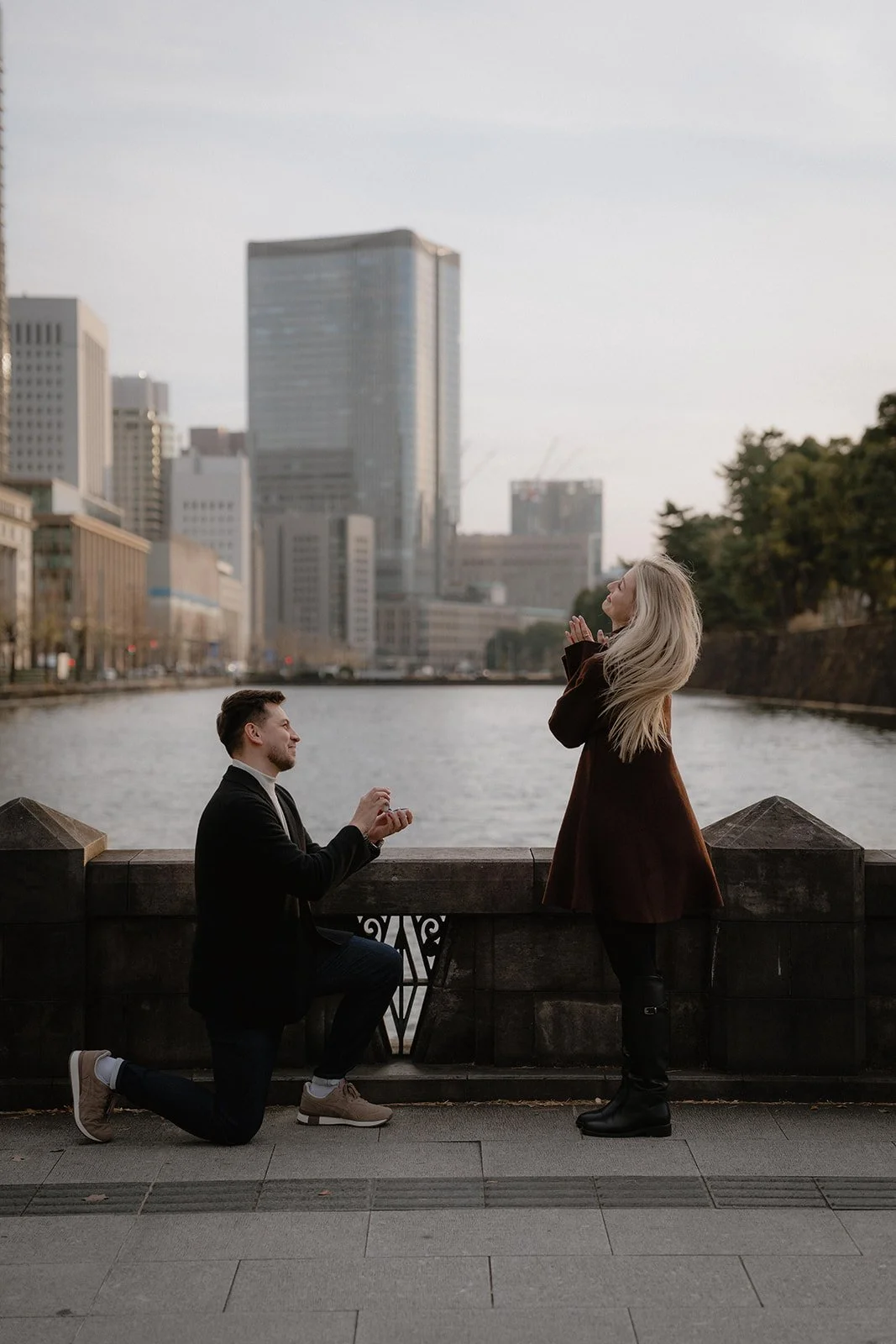
Two bridges do most of the work here: 中島橋 (Nakajima-bashi), the more versatile of the two, and 中の橋 (Naka-no-hashi), which also works well. Timing depends on the season, but late afternoon, around 4 pm, an hour before the park closes, is a strong window. Closing announcements start clearing people out around then, and the light is good. If an earlier option suits your schedule better, 9 am is the quietest time of day.
One thing to know going in: Hamarikyu sits inside a working city, with office towers visible from most angles. Some couples like the contrast between the garden and the skyline behind it. If you'd rather the background read as purely traditional, this isn't the spot.
Best time: ~4 pm (an hour before close) for light and thinning crowds, or 9 am for the quietest window.

Rikugien Gardens
Rikugien's Chidori Bridge is PMT's most documented proposal location, built around a real client story we can share in detail. The client had two days in Tokyo, no backup date, and chose Rikugien over Shinjuku Gyoen specifically for the privacy. The plan centered on the bridge: walk the partner to the center, pretend to take a photo of her from behind, then propose.
The photographer was already on the bridge when the couple arrived. At that hour there are usually a few other photographers around anyway, so one more goes unnoticed. Coverage started wide, to capture the bridge and the pond reflection, then moved in closer as the moment unfolded, giving the full arc of the reaction rather than a single frame.
Rikugien opens at 9am, so there's no earlier option for a morning proposal. In May specifically, 9am sun is already strong, but the garden's mix of open and shaded areas makes it workable anyway.
Best time: 9am at gate opening (no earlier option). Spot: Chidori Bridge.
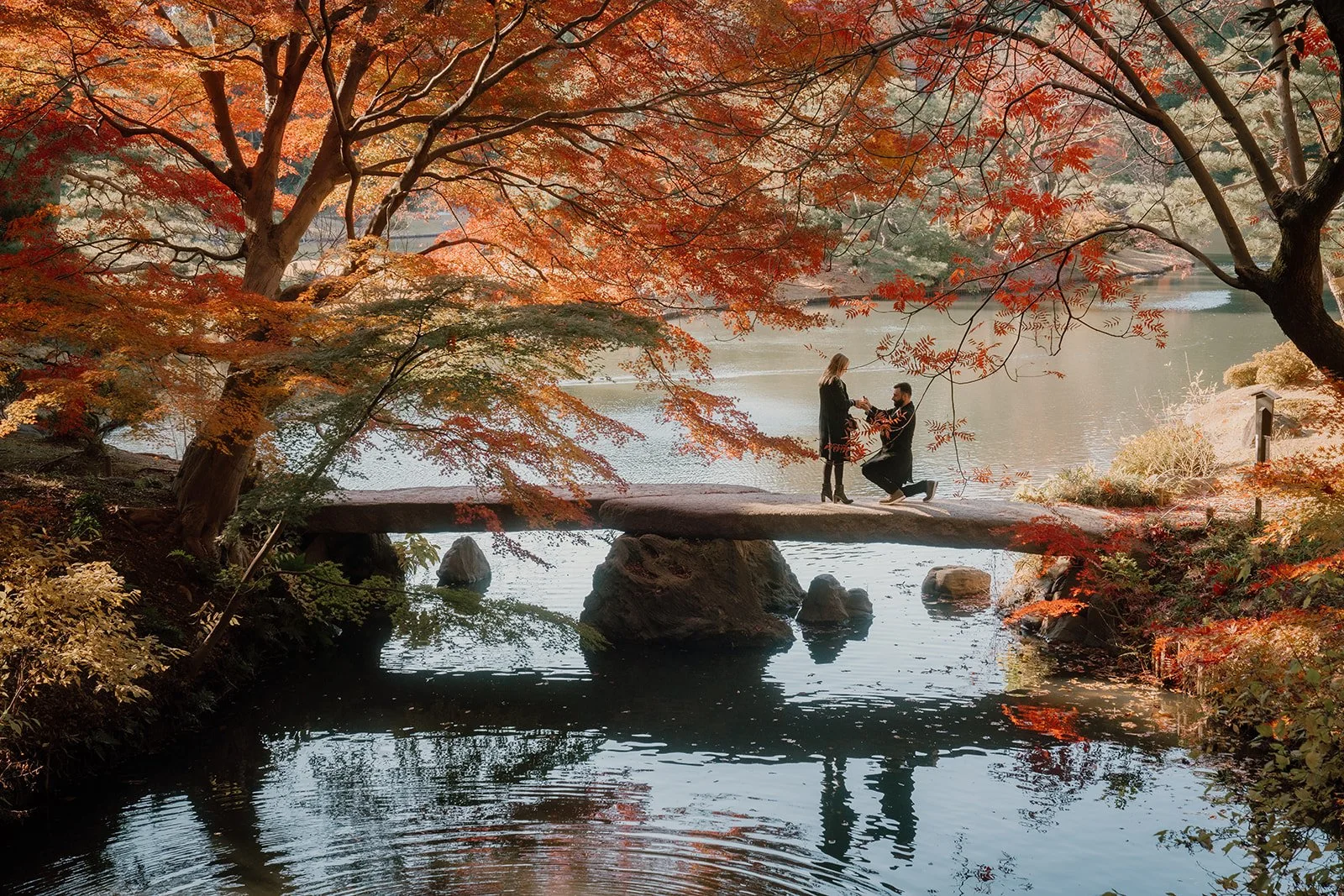
New Otani Garden
The most compact garden PMT shoots, tucked inside a hotel in central Tokyo. The red bridge is the preferred proposal spot, and most visitors never find this place, which keeps it quiet for most of the year.
Recommended timing here changes often rather than following a fixed rule. New Otani's hilly terrain, combined with the buildings surrounding it, causes sharper and faster swings in sunlight than most PMT locations, so timing gets reassessed shoot to shoot rather than locked in months ahead.
One window to avoid regardless of season: mid to late March, when graduating students use the garden for their own kimono photo sessions in large numbers.
Best time: Varies shoot to shoot, confirm closer to your date. Spot: the red bridge.

Shinjuku Gyoen
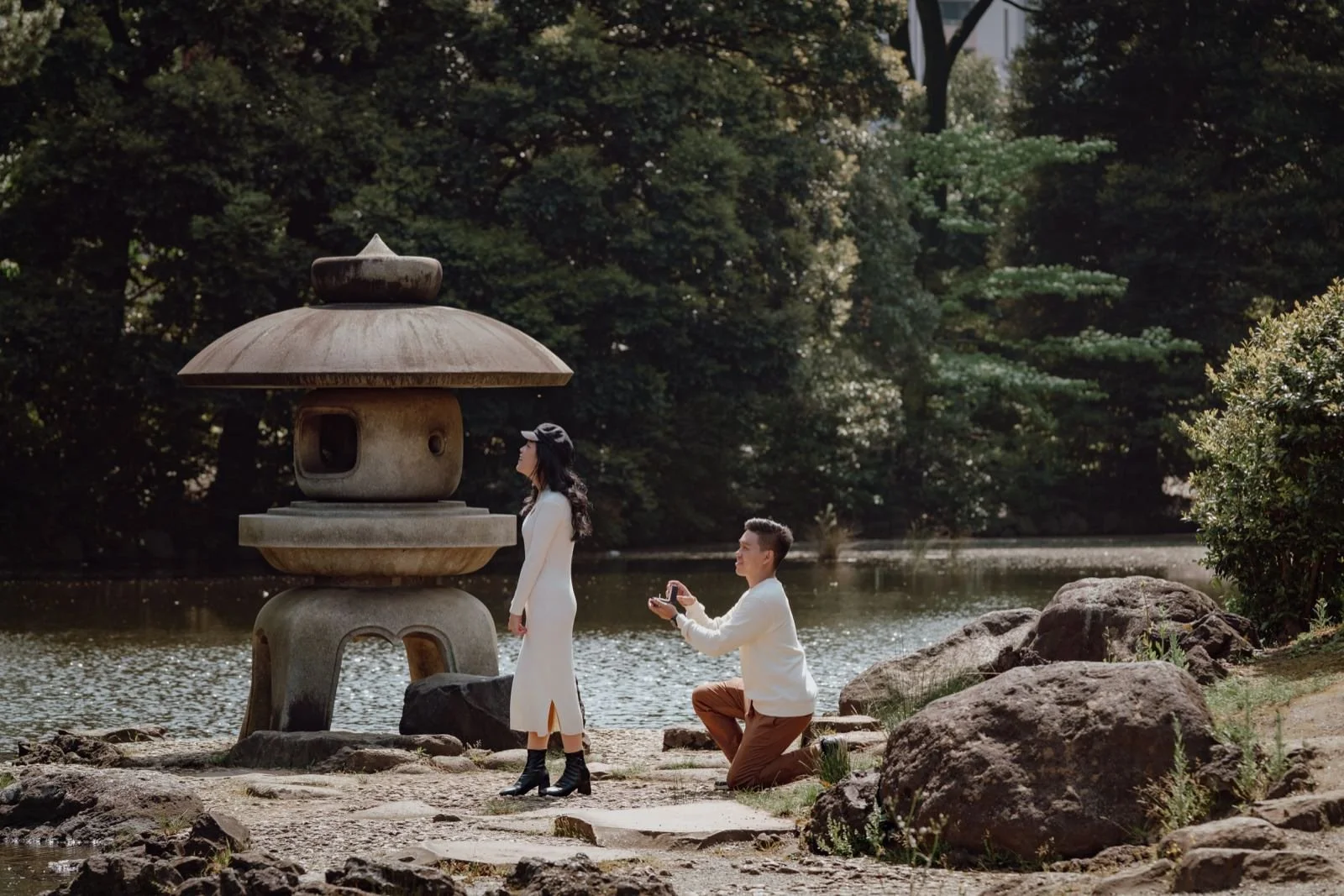
Several spots inside Gyoen work for a proposal depending on the season, but the standout is the stone lantern island and the bridges around it, tucked into a corner of the park that doesn't draw much foot traffic.
Best time: Season-dependent, arrive on time. Spot: Tamamo Pond and its bridges.
Hibiya Park
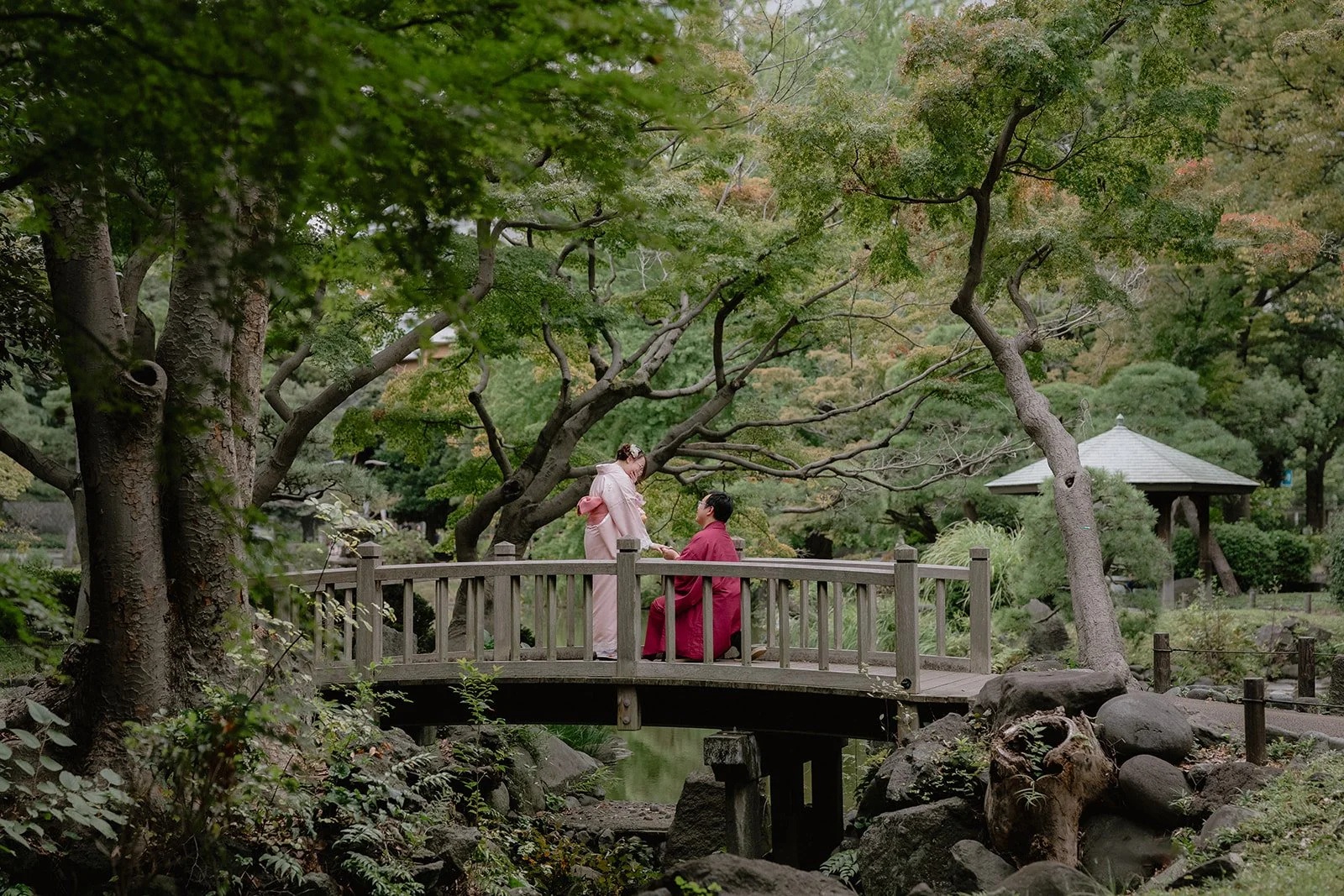
Outside autumn, the main proposal spot here is the wooden bridge near the pond. It's strong at sunset and reliably quiet, except when the park happens to have an event running.
Hibiya isn't a dedicated traditional garden, but the pond, fountain, and bridge give it enough of a Japanese-garden feel to work as one, with the advantage of being genuinely central.
Best time: Sunset (outside autumn). Spot: the wooden bridge near the pond.
Temples & Shrines
Tokyo's shrines and temples give a proposal a different register: red architecture, quieter grounds most of the year, and in two cases, a torii tunnel.
Meiji Shrine
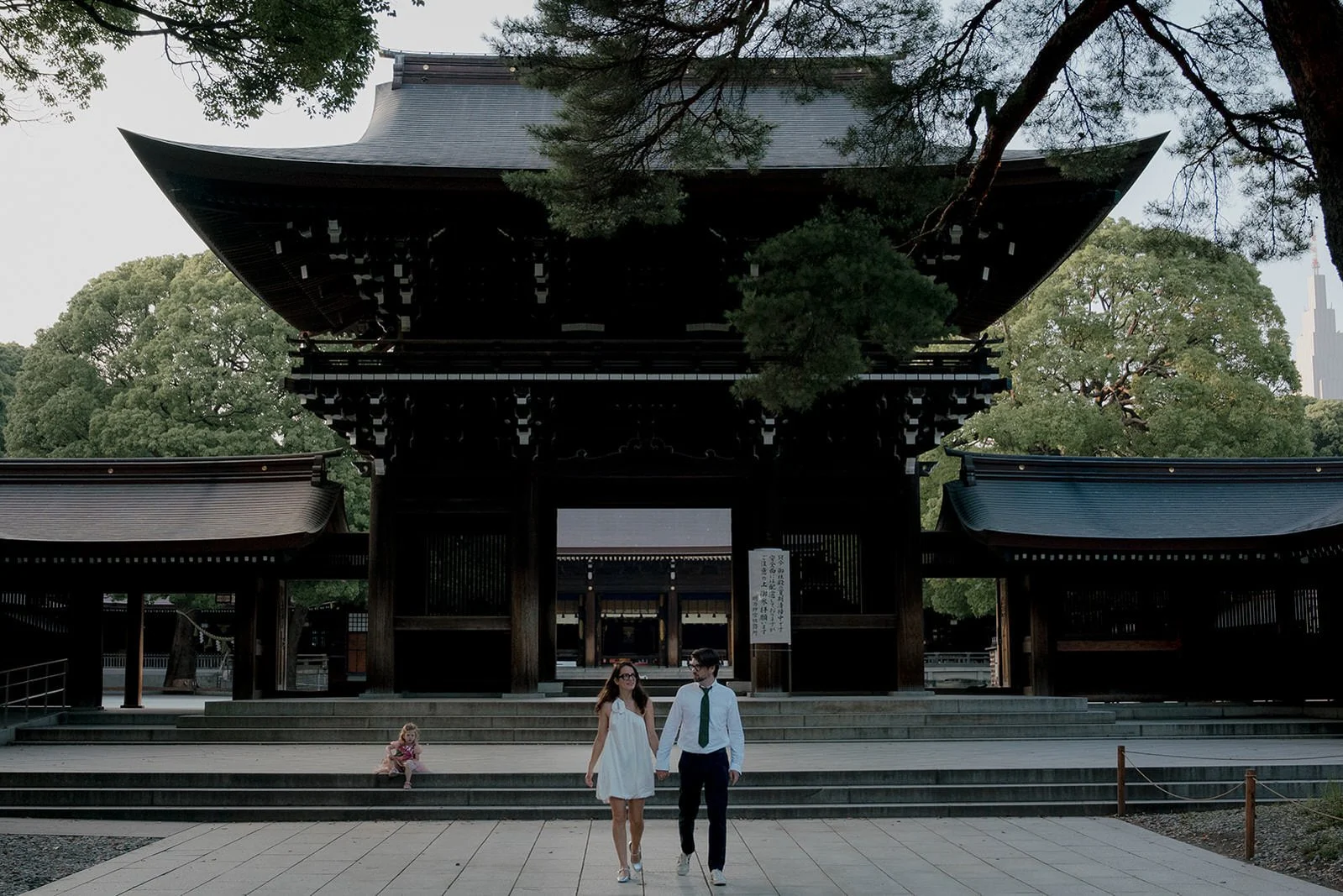
Early morning, up to 9 am, is the best window here. The specific spot along the walk from the main gate to the shrine varies shoot to shoot rather than following one fixed location. Meiji Shrine's scale works in its favor: even at its busiest, there's enough space to work around people in the background.
Best time: Early morning, up to 9 am. Spot: varies along the gate-to-shrine walk.
Asakusa
Before 8 am, while shop shutters are still down, Asakusa looks and feels different from the rest of the day, and that's the same window PMT uses for proposals here. No separate timing rule beyond the general early-morning approach.
Best time: Before 8 am.
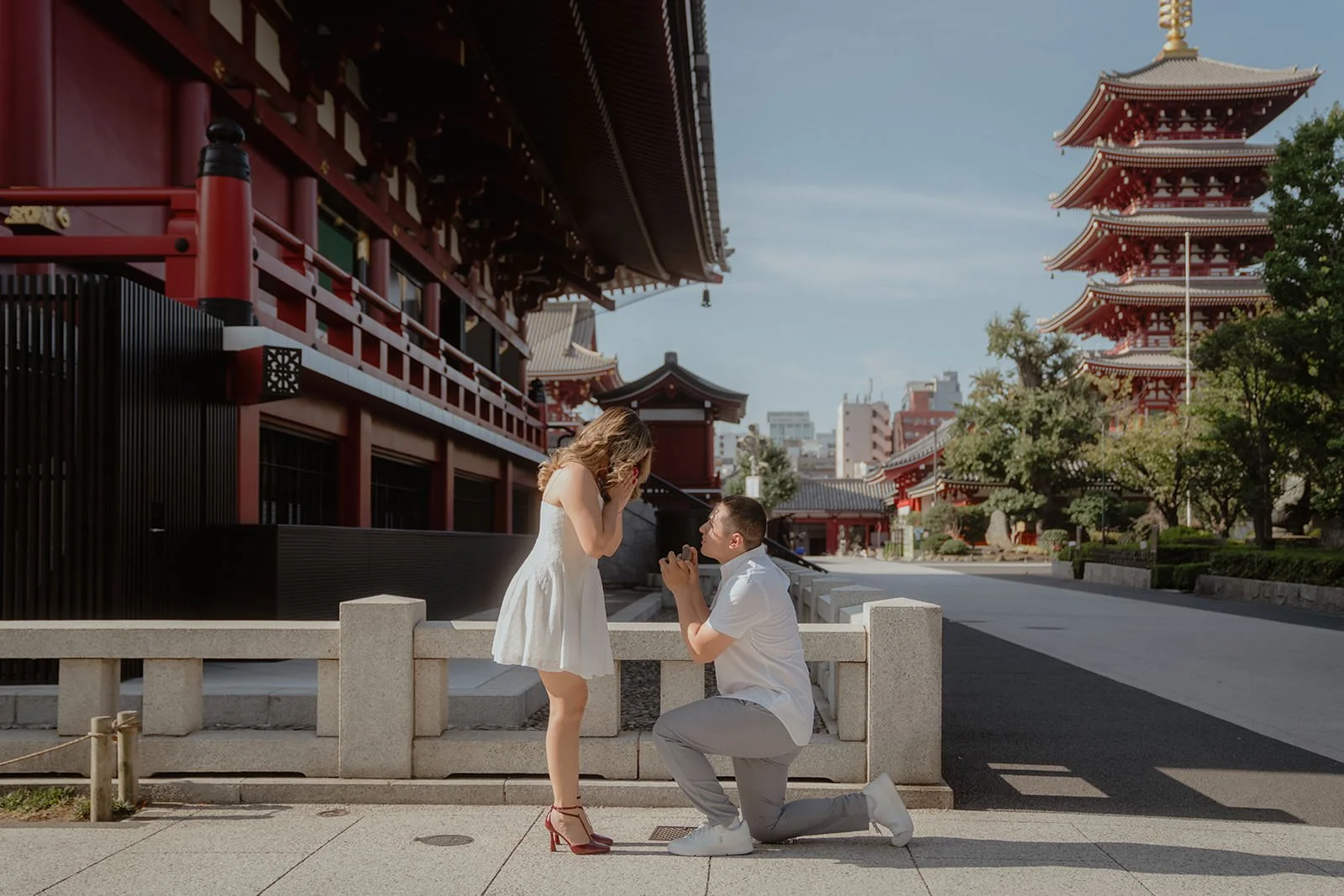
Nezu Shrine
There's an angle here that reads almost like a balcony, framed by the shrine's red architecture, and it's a genuinely strong proposal composition. Nezu also has a torii tunnel similar in spirit to Fushimi Inari's, but it tends to be busier than PMT would like for a proposal. For a tunnel shot specifically, PMT prefers Hie Shrine's tunnel instead (see below).
Best time: General shrine timing, quiet outside azalea bloom season. Spot: the red-architecture "balcony" angle.
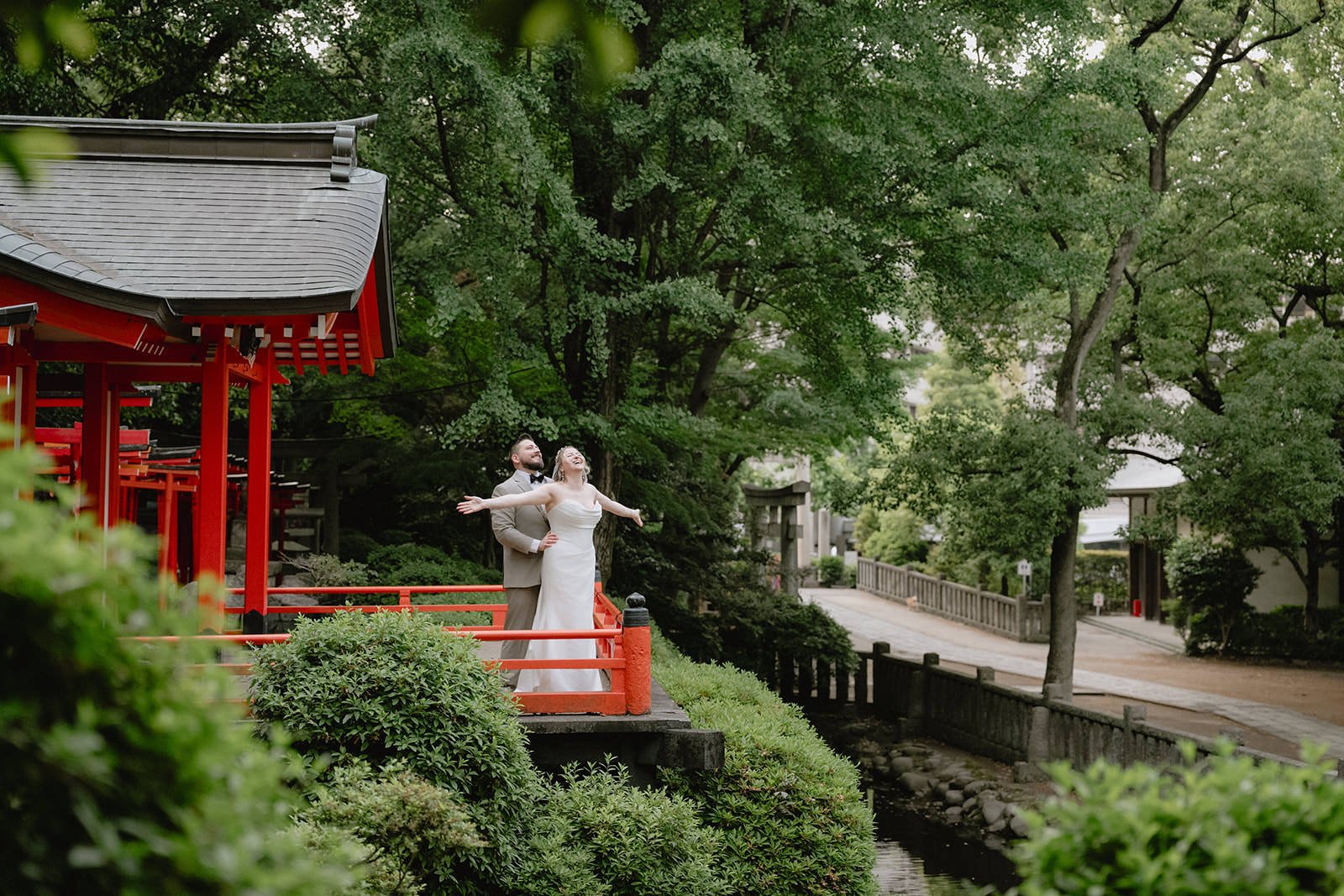
Hie Shrine
Hie Shrine's torii tunnel is the one PMT reaches for when a couple wants that specific look. The shrine is generally quiet, though the tunnel does draw a queue of people wanting their own photos when it's busier. In practice, that just means everyone takes a turn rather than the spot becoming unworkable. Mornings are the most reliable window.
Best time: Mornings. Spot: the torii tunnel.
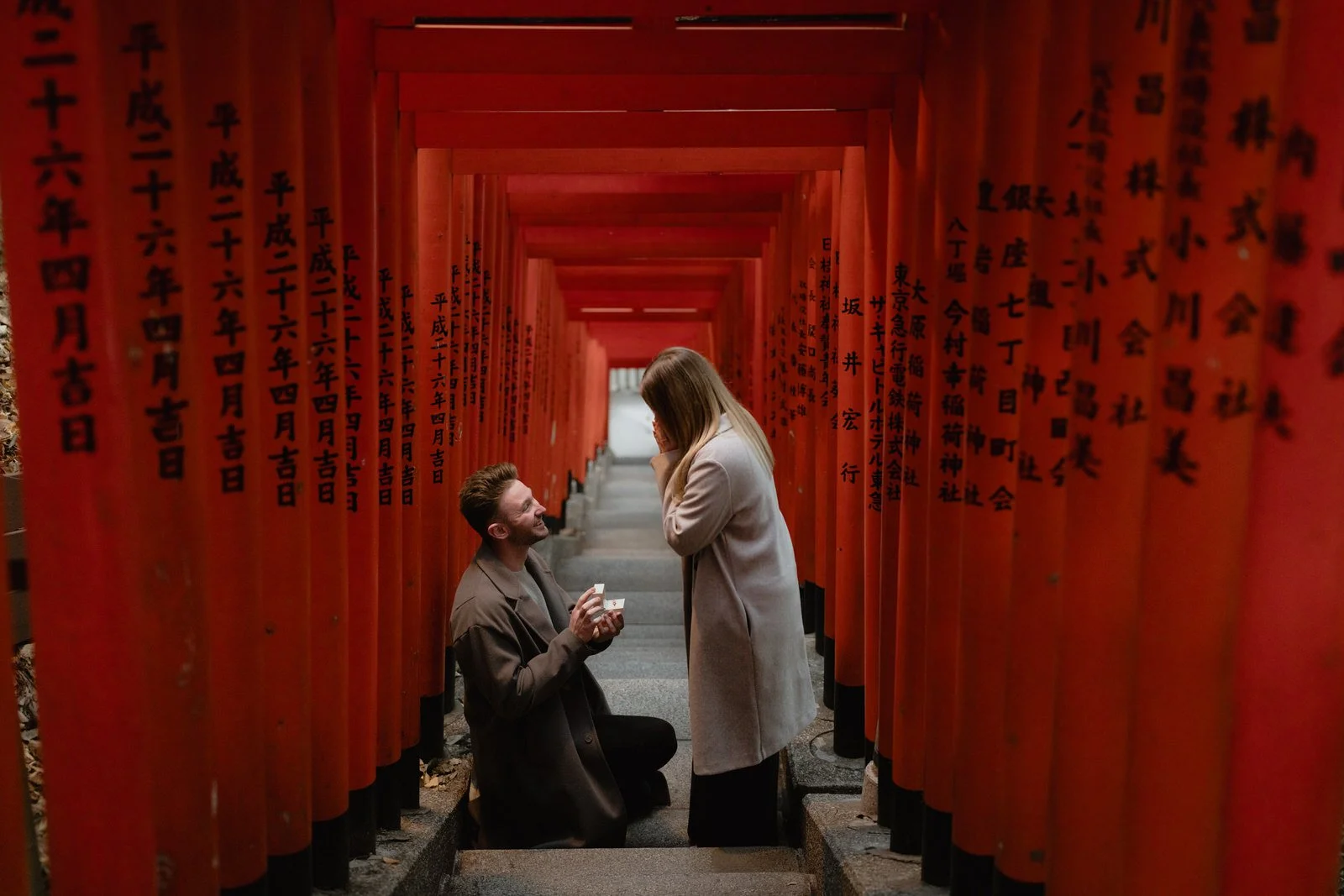
Zojoji Temple / Shiba Park
Zojoji's draw is the contrast between temple architecture and Tokyo Tower behind it. Several spots work for a proposal here, some from the open park area and some framed against the temple buildings, all keeping the tower in the background. Worth checking the temple's event calendar before booking, since stalls and crowds move through the area during certain events.
Best time: Flexible, check the temple calendar first. Spot: multiple, all keeping Tokyo Tower in frame.
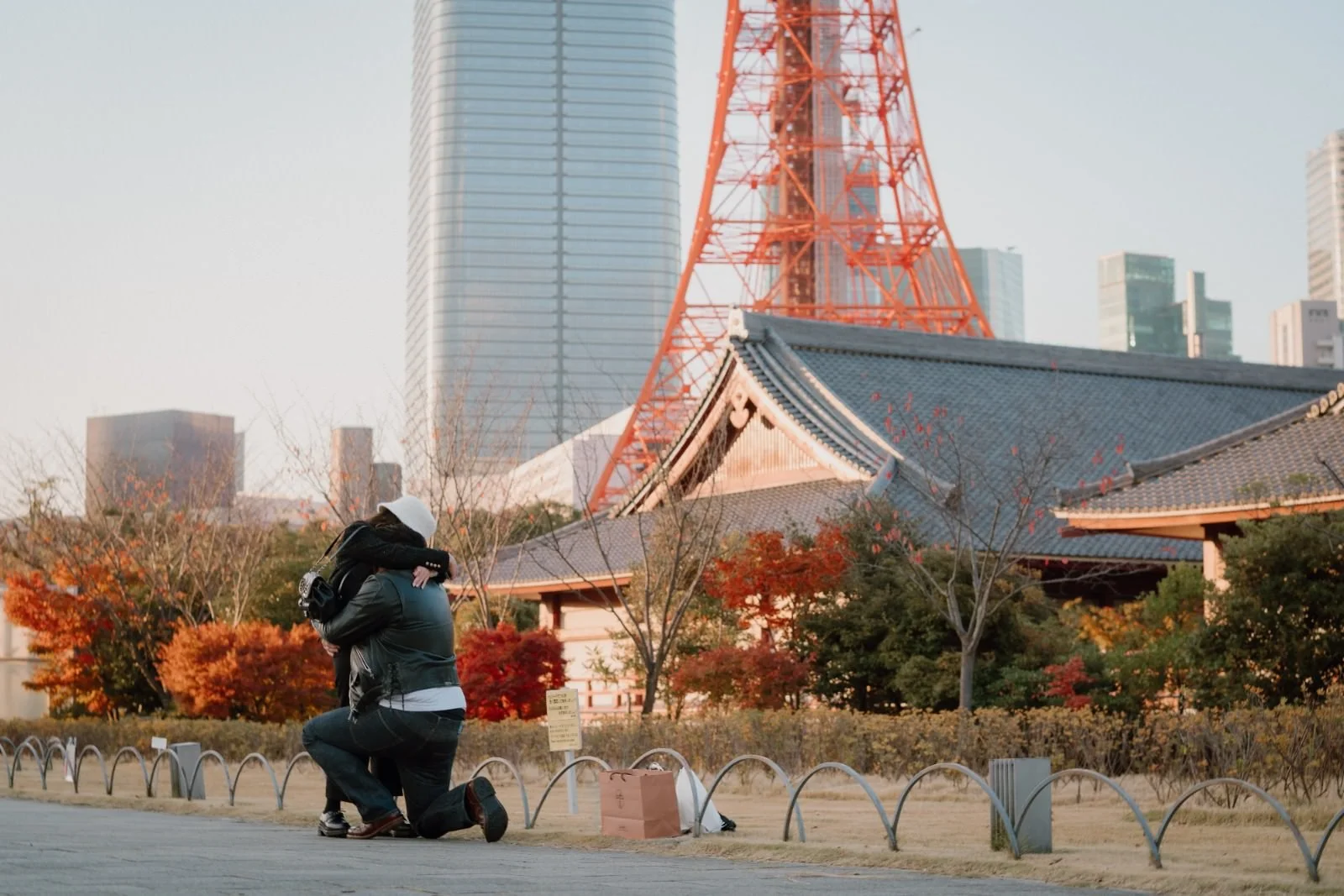
Urban Tokyo
Not every proposal needs a quiet garden. These three locations trade privacy for something else: architecture, a skyline, or, in one case, the crowd itself.
Marunouchi / Tokyo Station
Marunouchi's wide, planned streets and Western-influenced architecture make for a different kind of Tokyo backdrop, but it's also the least predictable location on this list. Tour buses can show up without any particular seasonal or event pattern behind them, so the crowd level here is harder to scout in advance than anywhere else on this guide.
Best time: Less predictable, scout closer to your date. Spot: varies, generally around the Nijubashi/Imperial Palace area.
Shibuya Sky
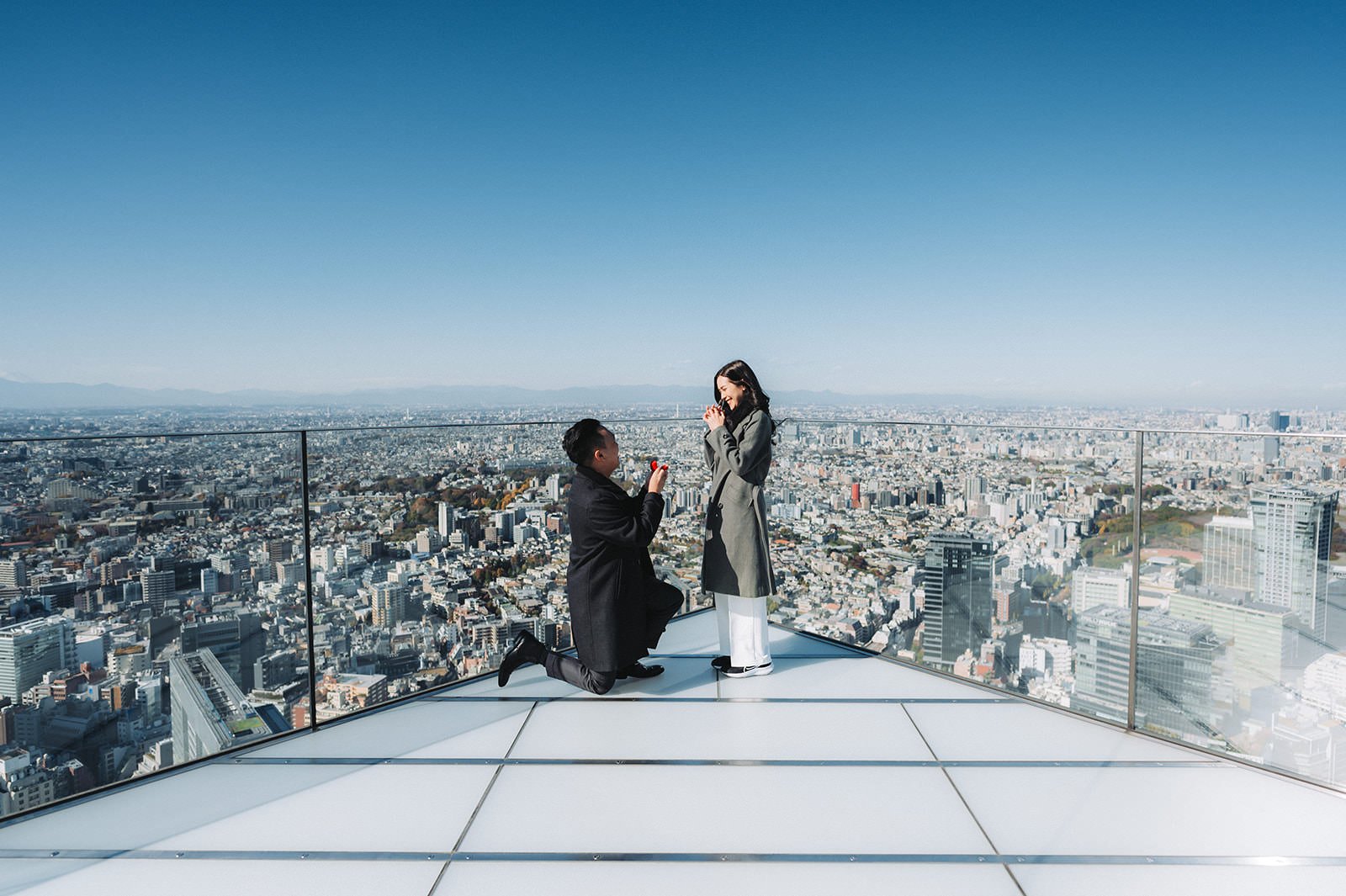
Shibuya Sky is a real PMT proposal location, but it comes with more moving parts than anywhere else on this list. Entry tickets, especially for sunset slots, sell out fast, and because the photographer needs to be on the deck with you, both of you need to book the same entry window ahead of time before it's gone.
The best spot on the deck is staff-controlled and queue-based, which rules out simply positioning the photographer in advance the way PMT does in a garden. Instead, the photographer and client agree ahead of time on how to recognize each other, then the photographer joins the same queue and enters right behind the couple. Once on the deck, it blends in naturally: people up there constantly ask strangers to take their photo or swap phones for a shot, so a photographer holding a camera near a couple doesn't stand out.
If the deck is closed for weather, the fallback is the indoor viewing area. It works, but it's busier and requires knowing which specific corners are usable, since it doesn't have the open sightlines of the deck. Treat it as a real backup, not an equivalent one.
Best time: Sunset slots sell out fastest; book both tickets early. Spot: staff-controlled queue area.
Shibuya Crossing
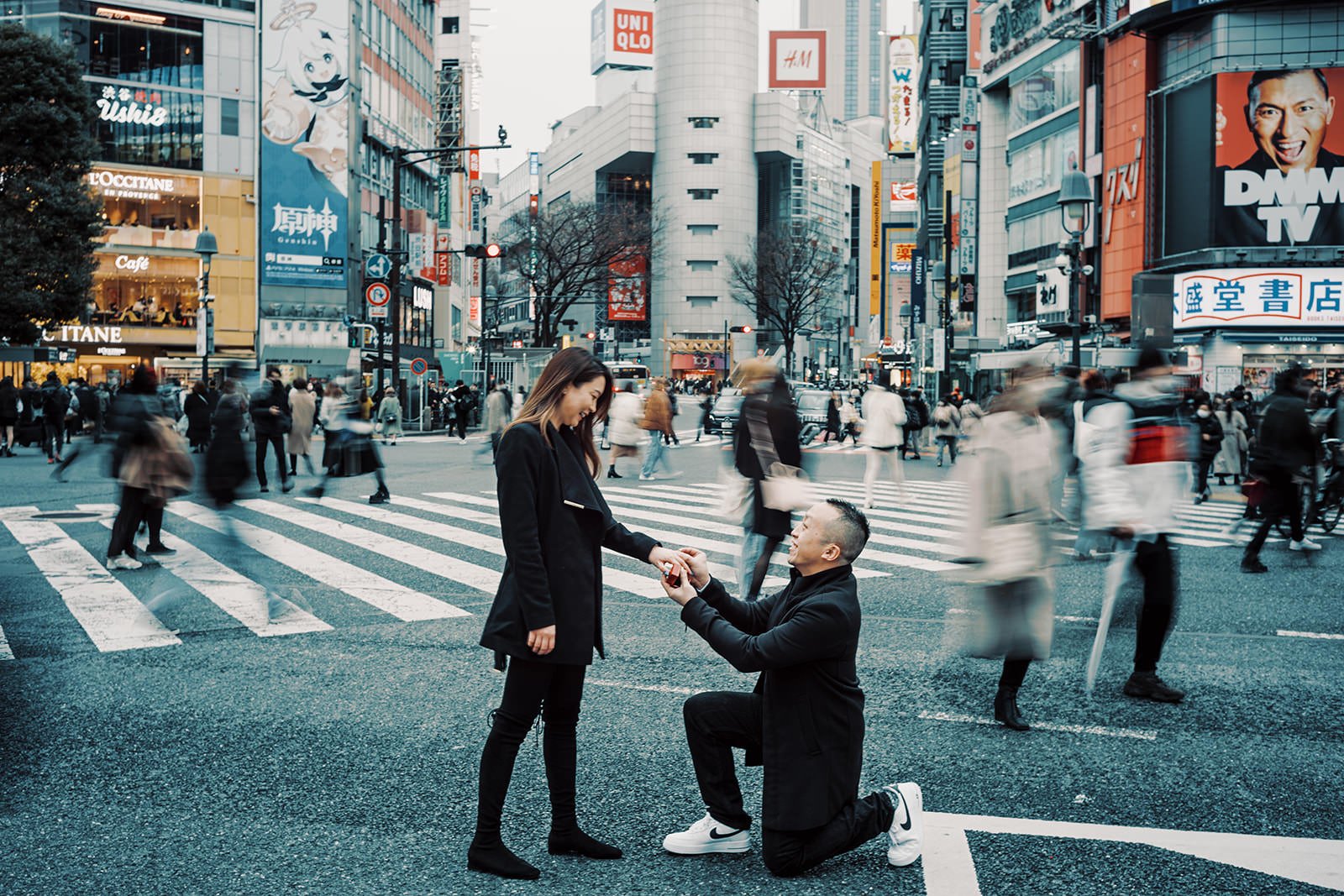
This one is for couples who want the crowd and the chaos as part of the memory, not something to avoid. It's always busy, and that's exactly the appeal for this specific kind of couple.
It's also the hardest location on this list to shoot discreetly. Instead of keeping the usual distance, the photographer has to stay noticeably closer to avoid losing the couple in the crowd or getting the shot photobombed. It's a real trade-off against how PMT works everywhere else on this list, and it's the point.
Best time: Anytime, the crossing is always busy. Spot: the crossing itself.
Proposing During Cherry Blossom Season
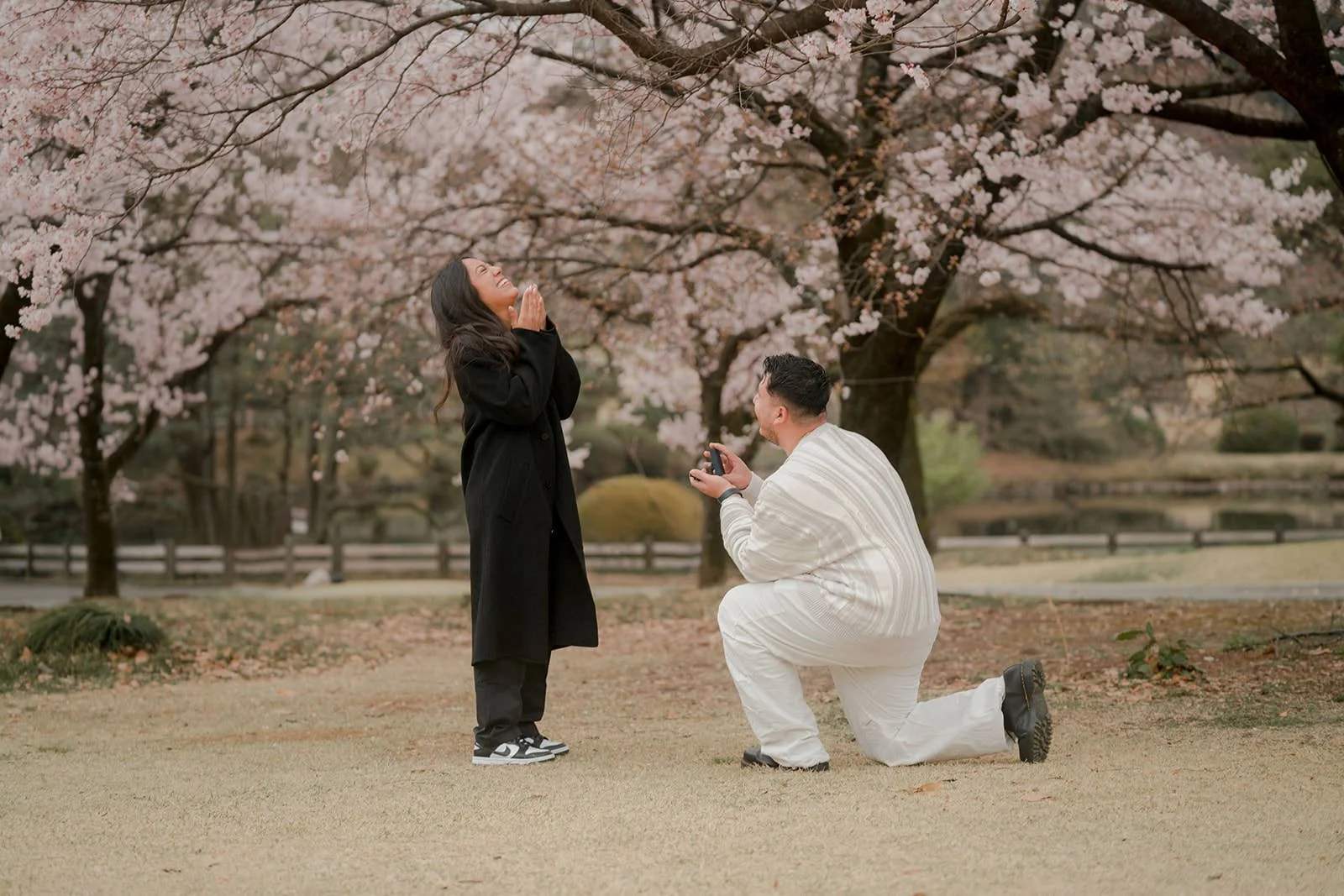
Cherry blossom season changes the crowd math at several of the locations above, most of all Shinjuku Gyoen. Somei Yoshino, the variety most people picture when they think "cherry blossoms," typically blooms the last week of March into the first week of April in Tokyo, and missing that window by even a week or two on either side often means missing the blossoms entirely.
The Gyoen story above, about the client who insisted he'd be fine with peak-season crowds and left without proposing, is worth repeating here specifically: sakura season at a location like Gyoen means real crowds, not the quiet garden photos you might picture. If a private, uncrowded feel matters more to you than being surrounded by blossoms, a location outside this season, or a different location altogether, is worth considering.
Proposing During Autumn
Autumn brings its own draw, mostly at Rikugien and Hamarikyu, both of which peak with deep red maple foliage around mid-December, later than most visitors expect "autumn" to run. For the fuller picture of how Tokyo's foliage timing actually unfolds season to season, PMT's guide to autumn in Tokyo covers it in detail.
One thing worth flagging if you're planning around Rikugien specifically: the garden runs illuminations for roughly three weeks in late November, and it gets too busy to shoot effectively during that window. Outside it, autumn at Rikugien is one of the quieter times to propose there.
A spot we would skip
Yoyogi Park comes up often in proposal lists, and we do not recommend it. It is not a bad park, but for a proposal, there are simply better options nearby that are quieter and more visually distinct, with Meiji Shrine right next door. The same logic applies more broadly: a location being popular online does not make it the right place to propose, and a few of the most-photographed spots in Tokyo are among the hardest to make feel private.
How PMT Keeps a Proposal a Secret
PMT treats every proposal as a surprise by default. The photographer doesn't interact with you or your partner until after the proposal has happened, and that only works because of what happens beforehand, not during.
Locations are scouted days in advance, never on the day itself. You'll get Google Maps pins and reference images of the exact spot, along with the best entry point into the park or area, so there's no hesitation finding it on the day. Instead of texting back and forth once you're there (which risks your partner noticing and asking what's going on), PMT coordinates over WhatsApp or a similar messenger and has you share live location once you're near the site. The photographer follows that pin rather than needing to exchange messages in the moment.
During the proposal itself, the photographer keeps a discreet distance and uses zoom lenses to capture the moment without being noticed, appearing to casually photograph other scenery nearby rather than pointing a camera directly at you. Once it's done, the photographer approaches, congratulates you both, and moves into a normal portrait session to celebrate.
You'll also get a Proposal Guide with tips on how to naturally walk your partner to the right place at the right time, including a reason to dress up that doesn't give anything away. The Rikugien story above is exactly why that guide exists: skip the cover story, and you risk being proposed to in whatever you happened to be wearing that day.
Two locations need a different approach than the rest of this list. At Shibuya Sky, the queue system replaces pre-positioning entirely (see above). At Shibuya Crossing, the photographer trades distance for proximity, since the crowd is the point rather than the obstacle.
What Can Go Wrong, and What PMT Does About It
None of what follows is specific to one location. These are patterns PMT has seen across dozens of proposals, and every one of them can happen almost anywhere on this list.
Arriving late costs you the quiet window. Every quiet spot on this guide depends on actually arriving on time, not just picking the right location. In one case, the photographer was in position at Shinjuku Gyoen's stone lantern island at gate opening and had the spot alone for the first fifteen minutes. The clients arrived thirty minutes late, and by then half a dozen people had turned up, including one person who stood at the pond for a long stretch watching the turtles. The background was fixable in editing, but the client didn't feel comfortable proposing with people visibly around, and ended up proposing in a rush at a different, less ideal spot instead. Showing up on time is often the difference between having a spot to yourselves and not, wherever you're proposing.
Crowd tolerance is a real self-assessment, not just a preference. Being fine with crowds in theory and being fine with them in the moment aren't always the same thing. One client insisted on shooting peak cherry blossom season at Shinjuku Gyoen on a weekend afternoon, confident he'd be comfortable with the crowds. On arrival, he felt overwhelmed, acknowledged the photographer, but didn't propose. He walked around the park instead while the photographer followed at a distance, and ultimately left without proposing at all. This can happen at any busy location on this list, not just Gyoen at sakura season.
The outfit decoy matters more than it sounds. PMT's Proposal Guide includes advice on giving your partner a reason to dress up without tipping them off, and it exists because of situations like this one: a client skipped that step before heading to Rikugien Gardens, simply inviting his partner to a park. She wasn't in the mood to dress up that day and wore something casual. After the proposal she said she wished she'd dressed up, though she took it well, joking that she'd been proposed to looking like she'd just left the gym. Skip the cover story anywhere on this list, and you risk the same outcome.
What you're carrying matters. One client arrived straight from a day of shopping, and both partners had shopping bags in hand. He set them down at an angle that couldn't be cropped or edited out while still keeping the requested background. The proposal itself went fine, but the bags ended up in every photo. If you're doing anything else that day, plan to arrive without your hands full.
Bringing a child changes the calculation. A proposal depends on several things lining up at once: location, timing, discretion. Taking a young child out tends to pull in the opposite direction, with a lot of improvisation and plans that can shift at short notice. If you're bringing a child along, PMT's recommendation is to keep the proposal itself as simple as possible, and to pick a location that isn't dependent on hitting one narrow crowd-free window, since a child can easily push your timeline later than planned. In one case, a couple's child woke up with a cold the morning of the proposal, and they had to stop on the way to care for her, arriving well behind schedule. Because the location and timing they'd chosen weren't dependent on a tight window, the proposal still went smoothly despite the delay.
When to Propose During Your Trip
Where matters, but so does when, and not just in terms of season. Proposal clients tend to be happier when the moment happens earlier in the trip rather than later. The anticipation builds the longer it's put off, and there's the added weight of hiding the ring the entire time.
That weight is real. One partner told us afterward that she'd found the ring in his toiletries earlier in the trip while looking for medicine, and simply said nothing, waiting for the moment to arrive on its own. Not every partner will handle that discovery so gracefully, and not every proposal survives days of unspoken tension before it happens. If your schedule allows it, proposing earlier in the trip, rather than saving it for the end, tends to make for a better experience for both of you.
FAQ
What's the best month to propose in Tokyo?
There isn't a single best month, only trade-offs. Cherry blossom season (late March into early April) is the most requested and the most crowded. Autumn, especially December, brings the deepest color at Rikugien and Hamarikyu with somewhat more manageable crowds. Winter is Tokyo's most underrated season for a proposal: clear skies, thin crowds, and consistently good light, without the pressure of a narrow bloom window.
How do you keep a proposal a surprise if a photographer is right there?
Through planning rather than luck. Locations are scouted in advance, the photographer positions or queues discreetly depending on the spot, and coordination happens through live location sharing rather than texting in the moment, so nothing has to happen on the day that could tip off your partner. See How PMT Keeps a Proposal a Secret above for the full breakdown.
What's the backup plan if it rains?
If you'd rather reschedule, that's accommodated as long as your photographer is available on an alternate date. Otherwise, PMT leans into the weather rather than fighting it: transparent umbrellas, a quieter version of the same location, and a more playful approach to posing in the rain. This doesn't change from location to location.
How much does a Tokyo proposal photoshoot cost, and how far ahead should I book?
A standard Tokyo proposal session runs ¥75,000 for 55 minutes; full details are on PMT's pricing page. On timing, book as early as your plans allow, and earlier still if Shibuya Sky is on your list: sunset entry tickets sell out fast, and both you and the photographer need the same slot.
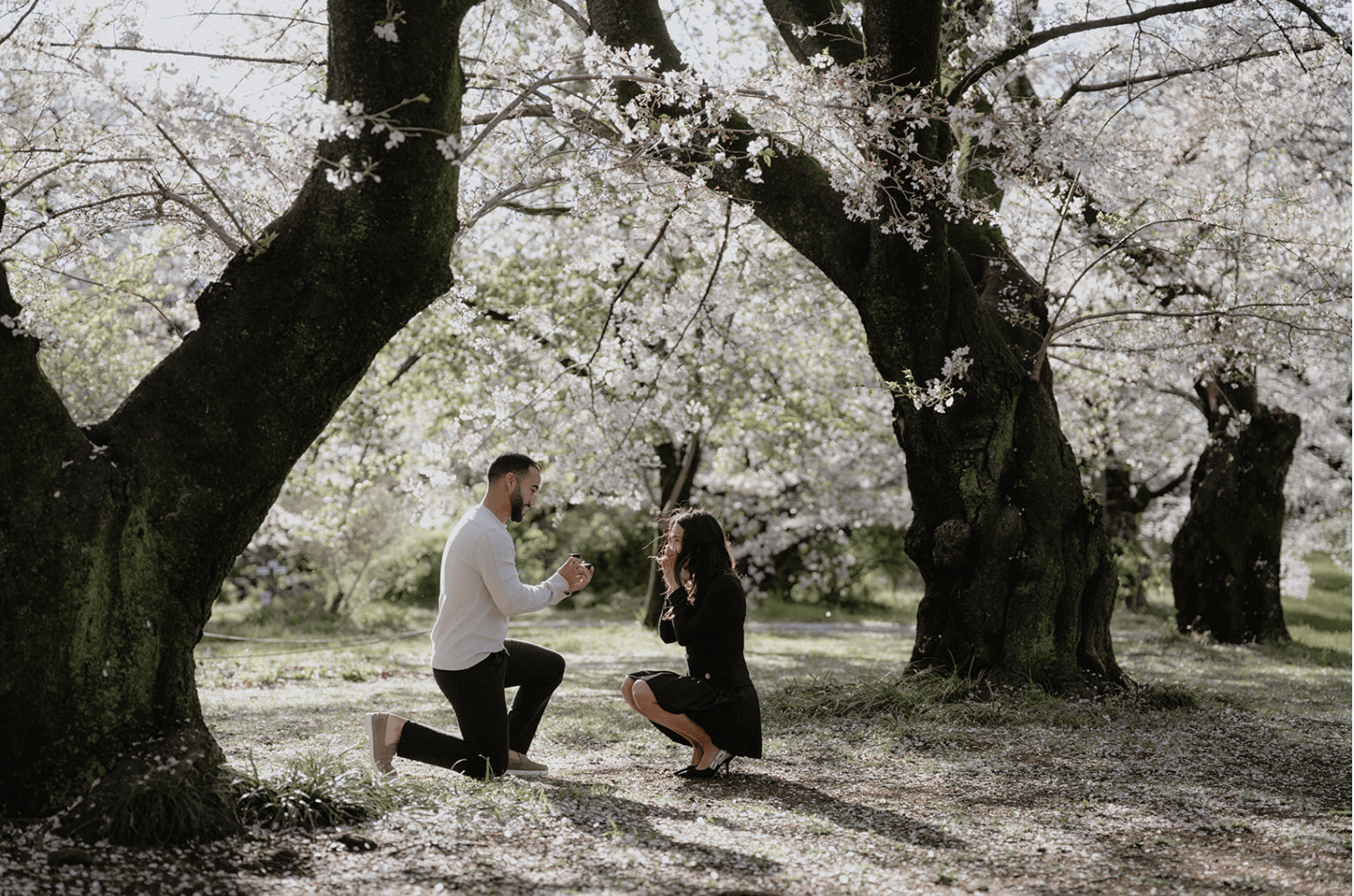
Planning Your Proposal in Tokyo
Every location on this list has one thing in common: PMT has actually stood there, planned the moment, and worked out what to do when something didn't go quite as expected. That's a different kind of guide than a list of pretty backgrounds.
If Tokyo isn't the obvious fit for your trip, Kyoto's temples and canal streets or a Mount Fuji backdrop in Kawaguchiko are both worth a look before you decide. PMT's guide to proposing in Kyoto and Mount Fuji proposal guide cover those in the same depth as this one.
When you're ready, start planning your Tokyo proposal, and PMT will handle the scouting, the timing, and keeping it a secret until the moment it matters.