
How to Plan a Mount Fuji Proposal at Kawaguchiko
A Mount Fuji proposal sounds simple until you remember the mountain does not always cooperate. Fuji hides behind cloud far more often than most visitors expect, and the weather around Lake Kawaguchiko can turn in under an hour. The couples whose proposals work out are not the ones who got lucky with a clear summit. They are the ones who planned around the uncertainty instead of betting everything on it. This guide walks through the decisions that actually shape the day: when to go, where to stand, whether to stay overnight, how to run the surprise, and what to do if Fuji never appears. Get those right and the proposal holds up whether or not the mountain does.
The one thing to accept first
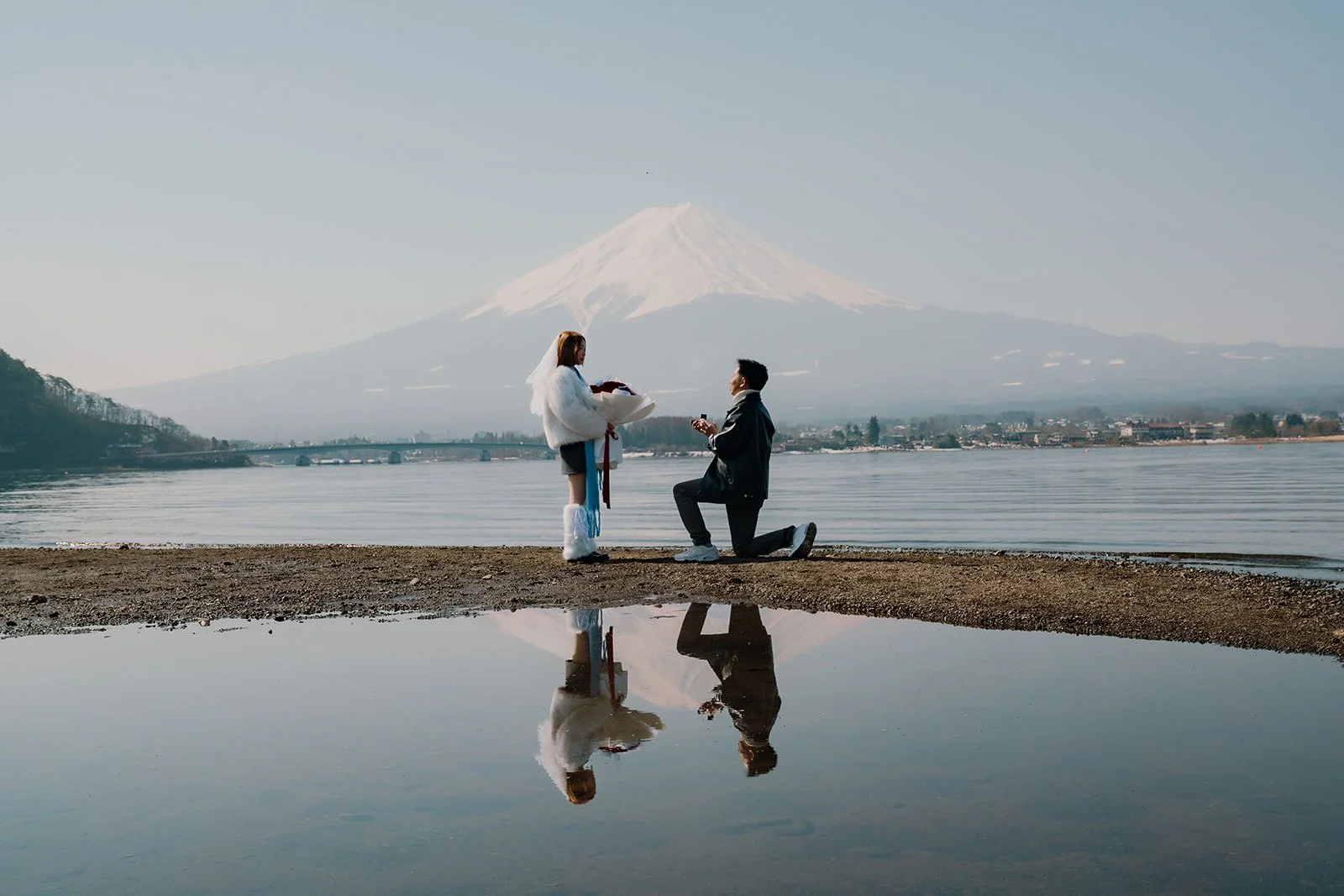
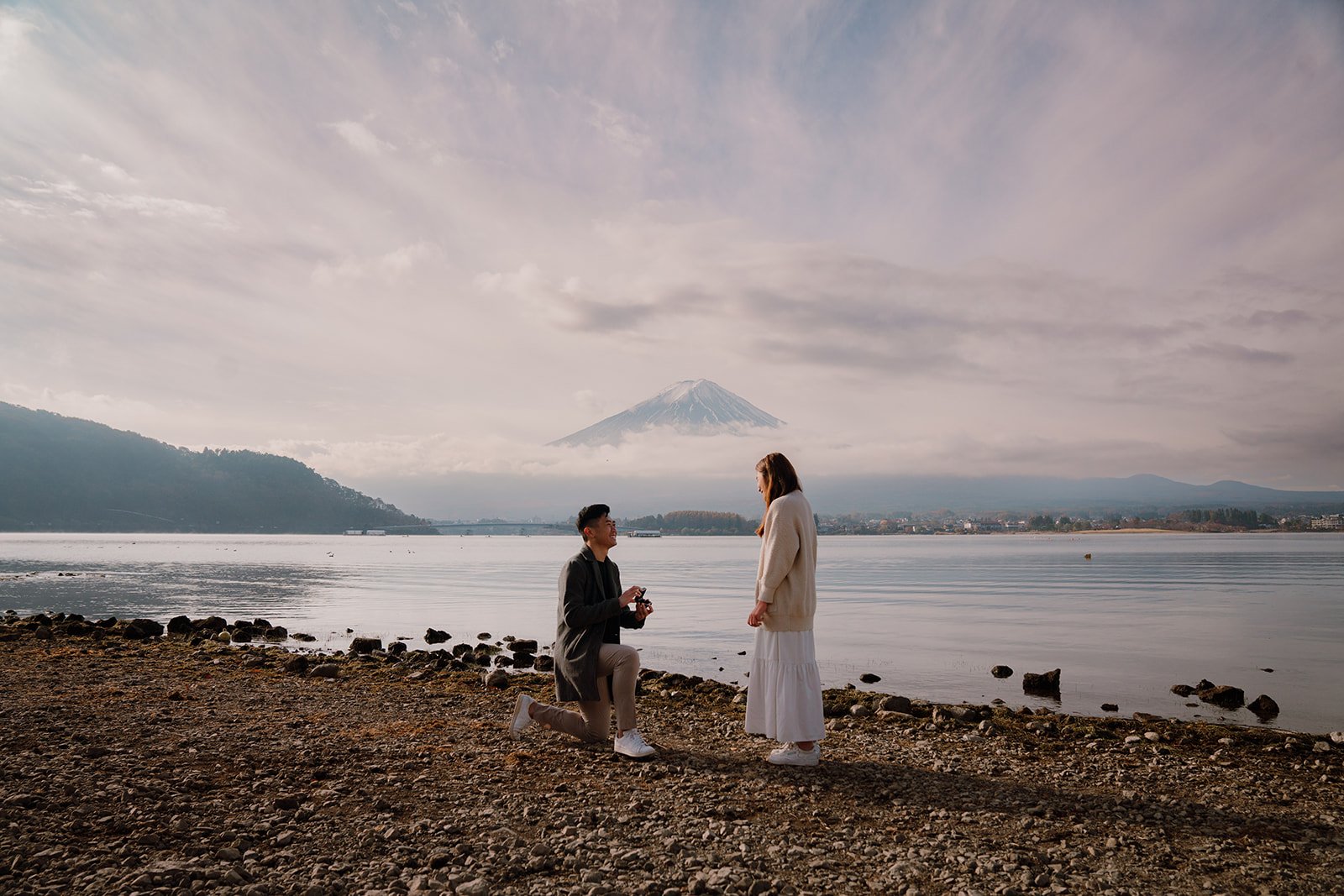
Before anything else, accept that you cannot control whether Fuji is visible. Lake Kawaguchiko sits in a basin ringed by mountains, and that geography makes the weather shift fast. A summit that is wide open at first light can vanish by mid-morning, and a grey, hopeless-looking sky can clear in forty minutes. Planning a proposal here means planning for a mountain that may or may not show up.
The visitors who struggle are the ones who treat a clear Fuji as the whole point. We have watched it go wrong in a specific, avoidable way. One partner spent the session stalling, waiting for the clouds to lift, making excuse after excuse to delay. The person being proposed to had no idea what was coming, only that they were standing around in the cold while their partner seemed distracted and indecisive. By the time the proposal finally happened, the mood had drained out of it. The mountain showed, eventually. The moment did not.
The lesson runs through every good proposal here: build the moment around the person, not the backdrop. Fuji is a bonus. If you decide that in advance, the day is yours regardless of the weather.
Mt. Fuji on a shy day
When to go: season and time of day
If you want the best odds of a clear Fuji, the answer is not a season. It is a time of day. Sunrise is the most reliable window of the entire year. Mornings are statistically clearer, the air is stillest, and almost nobody else is awake to share the view. A sunrise proposal stacks two advantages at once: the highest chance of seeing the summit and the smallest chance of strangers in your photos.
Season still matters, mostly for crowds and for what Fuji actually looks like. Clear mornings are more common in winter and early autumn, though even then the summit tends to cloud over by mid-morning, which is another argument for starting early. The rainy season, roughly June into July, is the hardest stretch, with visibility dropping sharply for days at a time.
Two seasonal details catch people off guard. The busiest time of the year is November, when autumn color peaks around the lake and events like the autumn-leaves festival pull in large crowds; the famous viewpoints get difficult to work, and timing has to be tighter. And from summer into early autumn, the snowcap melts off the summit entirely. If you are picturing the classic snow-topped Fuji, that version of the mountain is not there in those months. It is still a striking peak, just a bare one.
Where to plan: the North Shore
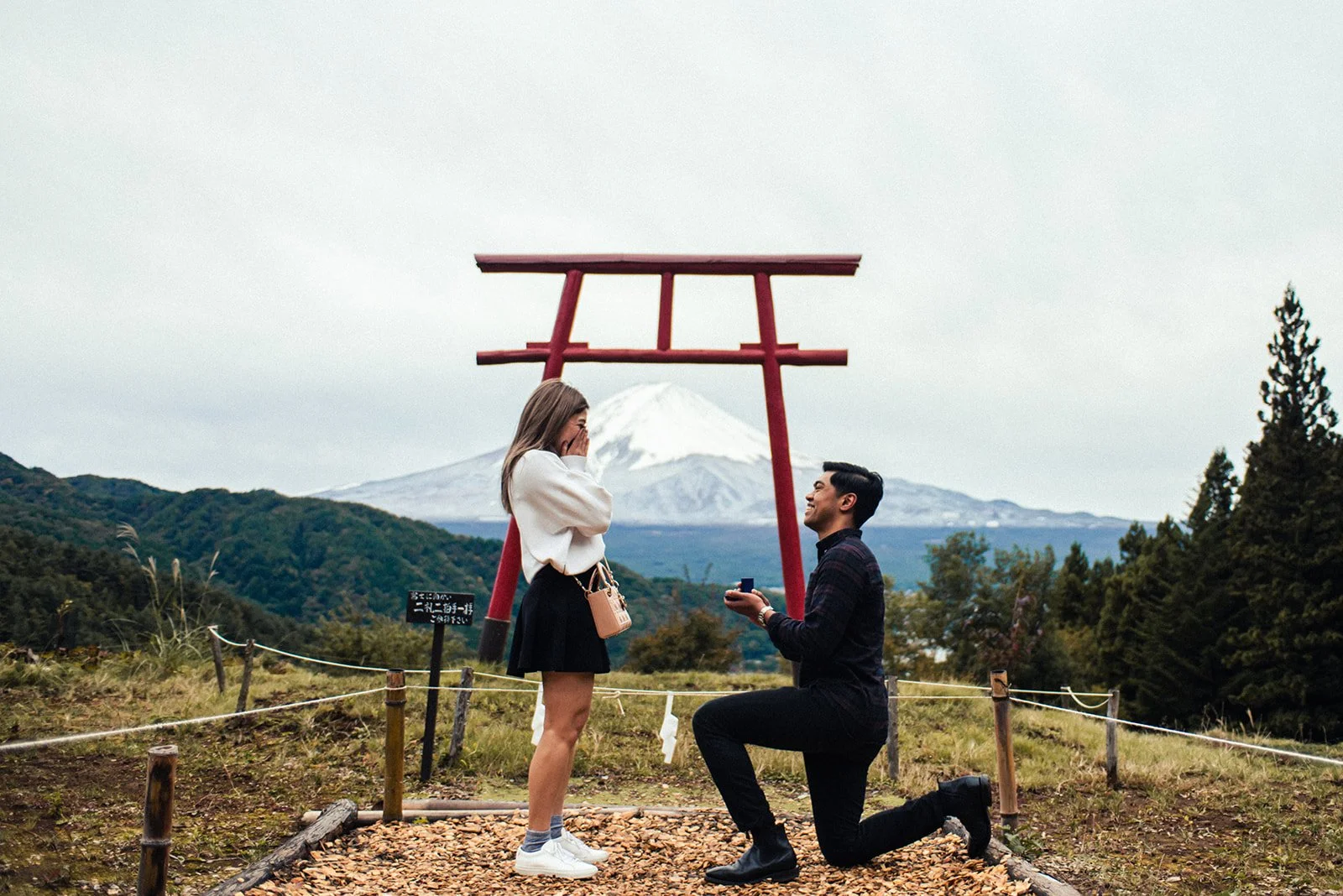
The strongest area for a Kawaguchiko proposal is the North Shore of the lake. It gives you the best combined view, the water in front of you and Fuji rising behind it, which is the composition most couples have in mind without quite being able to name it.
A word of caution on the well-known spots. Oishi Park and the Chureito Pagoda are the two viewpoints most people find first, and both get very crowded, especially in autumn. They earn their reputation, but a proposal in the middle of a packed observation deck is a different experience than the one in the photos that drew you there. The North Shore is large, and a photographer who works the area regularly will steer you toward quieter positions with the same view. The practical rule is simple: favor the North Shore in general, arrive early, and do not assume the most famous spot is the best one for a private moment.
Check out our Kawaguchiko Proposal page for more location ideas.
The travel tax: day trip or overnight
Here is a logistics reality that shapes the whole day. There are no professional photographers based in Kawaguchiko. Anyone you book travels in, usually from Tokyo, and the trip eats most of a day in each direction. That is why a Mount Fuji session costs more than a comparable shoot inside the city; you are paying for the day, not just the hour in front of the lake.
It also affects you directly. Roughly half of the couples we work with stay overnight near the lake, and half make it a day trip. If your itinerary is still open when you start planning, stay the night. It is the single best thing you can do for a Fuji proposal, because it puts you on site for the sunrise window without forcing a brutal pre-dawn departure. The couples who day-trip almost always leave Tokyo before dawn to arrive in time, and that is genuinely taxing. A lot of people underestimate this travel tax, the cumulative cost of a long, early round trip, and arrive tired before the proposal has even begun. If your schedule is locked and a day trip is the only option, plan for it honestly: build in the early start, the travel fatigue, and a slower rest of the day. You can read more about the area on the Kawaguchiko destination page, and the how it works overview covers the planning side of a session.
Planning the surprise
A surprise proposal has a built-in tension: one person is fully prepared, and the other has no idea. Everything depends on getting the unaware partner to the right place at the right time without raising suspicion, which is harder at a destination like Kawaguchiko, where a full day's outing has to feel natural rather than oddly choreographed.
The more precisely the logistics are planned in advance, the location, the timing, the route, and a believable cover story, the more your photographer can focus on reading the moment instead of managing it. A good proposal photographer will work this out with you beforehand: where they will be positioned, how you will arrive, what marks the moment, and how to keep the surprise intact until it happens.
It’s no secret by now that certain spots around Kawaguchiko are suffering from crowds. That’s something that can play in your favor. Telling your partner that there’s a special spot at sunrise where you can see Fuji by yourselves can be an excellent reason to justifiy the early bird call.
If Fuji does not show
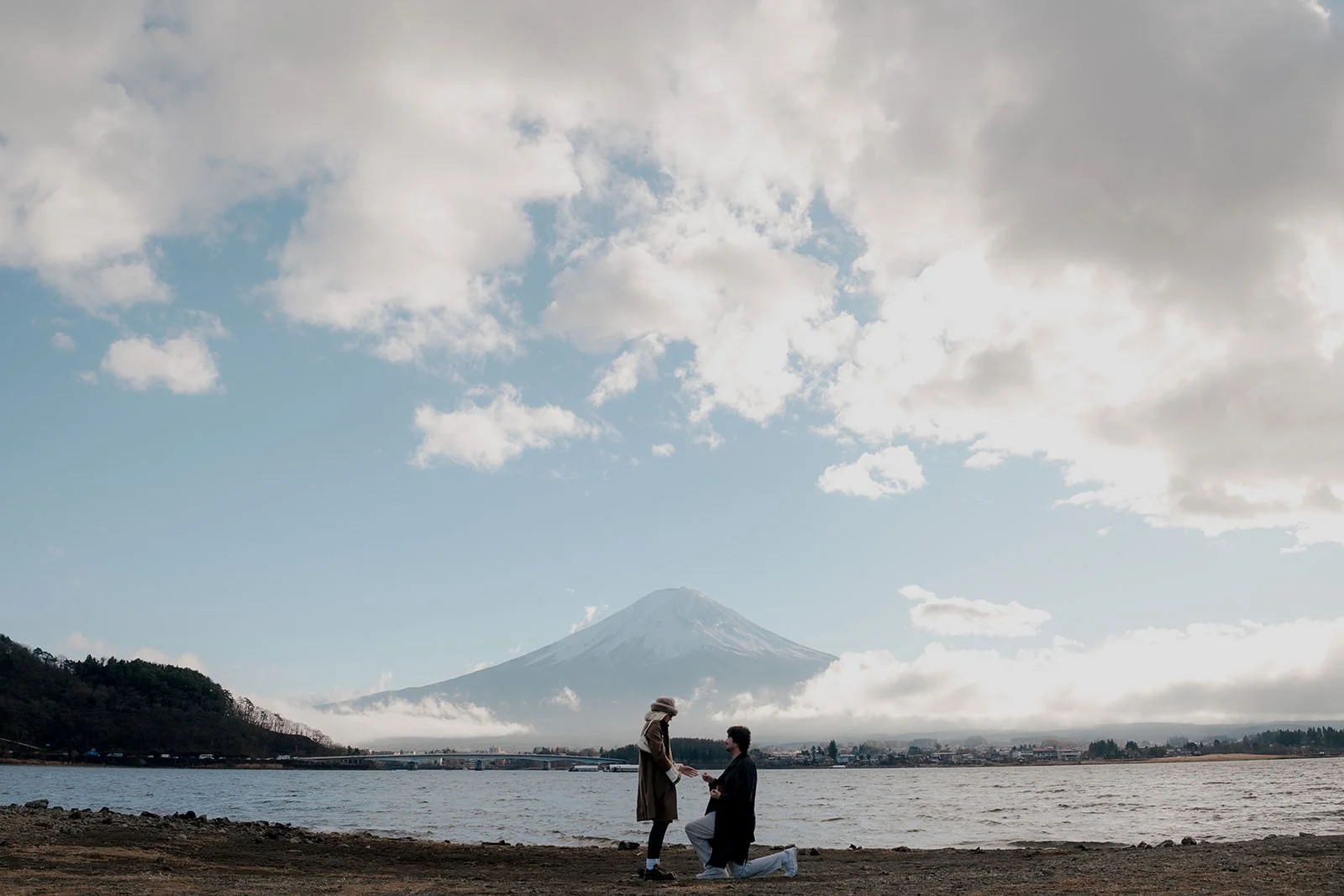
Plan for the version of the day where the mountain never appears, because some of the time it will not. There are two honest responses, and you should decide which one is available to you before you go.
The first is flexibility. If your schedule and your photographer's allow it, you can hold and try again, often the next morning. The weather here rewards patience of the right kind. We once arrived for a session with Fuji completely socked in, with the next morning held as a backup. Mid-day, the wind picked up hard and cleared the summit in about forty minutes. A quick message to the client, a fast decision to come back, and the proposal happened at golden hour with a fully open mountain. The flexibility is what made it possible.
The second response is acceptance. If you cannot reschedule, lean into what is in front of you. Even without the summit, Lake Kawaguchiko is a calm, open setting that carries a photo well on its own. The couples who do best are the ones who stop fighting the conditions and commit to the moment. The flip side is just as real: we have seen a thirty to forty minute delay, a client caught in traffic, cost a couple a clear summit that was there when they were due to arrive and gone by the time they did. Conditions move quickly in both directions, which is exactly why rigidity, whether it is waiting too long or running late, tends to backfire.
Either way, you get a result you are glad to keep. The mountain is the bonus. The decision to go ahead is what makes the photos worth having.
Before you go
A Mount Fuji proposal is a good decision made under uncertain conditions, which is most of what travel planning actually is. Pin down the parts you can control and let go of the part you cannot. Aim for a sunrise on the North Shore for the best odds and the fewest people. Stay overnight if your itinerary still allows it, and budget for the travel tax if it does not. Plan the surprise down to the route and the cover story so the moment runs smoothly. And settle, before you arrive, that you will go ahead whether or not Fuji is out. Do that, and you are not hoping for a perfect morning. You are ready for any morning, which is the only plan that reliably works here.

Frequently asked questions
Is Mount Fuji always visible from Kawaguchiko?
No, and this is the one to internalize. Clearer mornings are more likely in winter and early autumn, but the summit often clouds over by mid-morning, so plan for the chance it is hidden.
What is the best time of year for a Mount Fuji proposal?
Winter and early autumn for the clearest mornings; avoid the rainy season (June into July) for visibility and November for crowds. Whatever the season, sunrise is the most reliable window.
Can you propose at Chureito Pagoda or Oishi Park?
You can, but both get very crowded all year long. Chureito Pagoda requires an early morning for a quiet shoot. Oishi Park peaks at certain flowering seasons, such as the kochia in mid to late October.
Should we day-trip from Tokyo or stay overnight?
If your itinerary is open, stay overnight; it puts you on site for sunrise without a pre-dawn trip. Day trips work but mean an early, tiring round trip.
How far ahead should we plan?
Sort the photographer and the surprise logistics (route, timing, cover story) well in advance, and build itinerary flexibility so you can shift to a clearer morning if needed. Because photographers travel from Tokyo for the shoot, the earlier you prepare, the better your chances of working with flexibility, such as booking a backup date in case Fuji is not visible.